Temple Neuf, Metz, Protestant church on Petit-Saulcy island, Metz, France
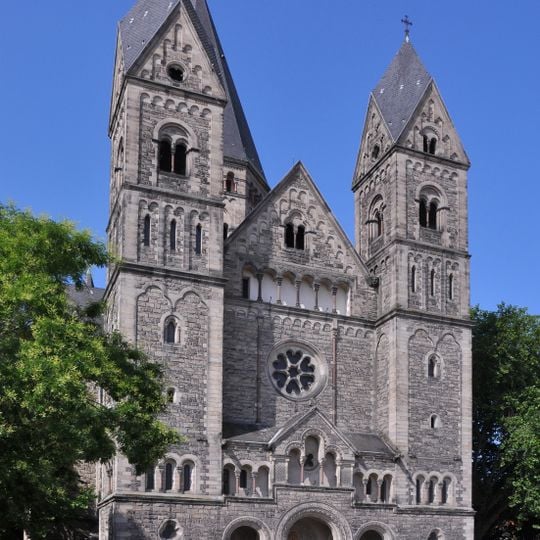
The Temple Neuf is a Protestant church on the Île du Petit-Saulcy, surrounded by the Moselle. Its west facade has two flat-fronted towers with steep pyramidal roofs, the left one broader and taller, and a central rose window above a round-arched porch. The dark Vosges sandstone exterior contrasts with the light Jaumont limestone of nearby buildings.
In 1898 the Reformed community received a willow-planted plot, the Jardin d'Amour on Île du Petit-Saulcy, for a church in Rhenish Neo-Romanesque style. Metz's chief architect Conrad Wahn designed it, and the first stone was laid on 25 November 1901 by Statthalter Hermann zu Hohenlohe-Langenburg. Wilhelm II inaugurated the church on 14 May 1904, accompanied by the empress and Princess Victoria Louise. The facades and roofs were classified as monuments historiques on 6 January 1930.
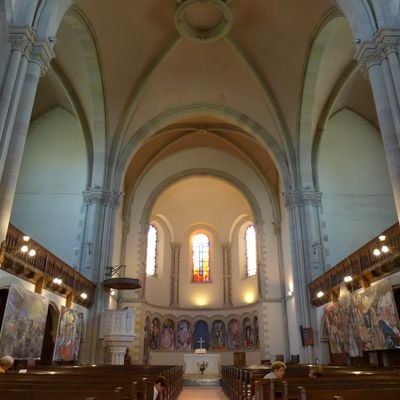
The congregation of Reformed Protestants continues to gather here for worship, and the building's exceptional acoustics have made it a preferred venue for musical performances throughout the year. The organ inside plays a central role in this musical tradition.
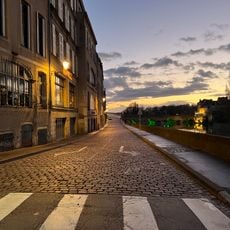
The church stands on the Île du Petit-Saulcy, on the southwestern edge of the island, beside the Opéra-Théâtre on place de la Comédie, with the Moselle flowing on both sides. It remains the gathering place of the Reformed Protestant community of central Metz, so visits are best timed around its services. The main entrance is on the west facade, under the rounded arch of the projecting porch.
The building stands out in the cityscape by using gray Vosges sandstone rather than the local yellow limestone commonly seen in other Metz structures. This material choice creates an immediate visual distinction that catches the eye of anyone walking through the area.
The community of curious travelers
AroundUs brings together thousands of curated places, local tips, and hidden gems, enriched daily by 94,073 contributors worldwide.