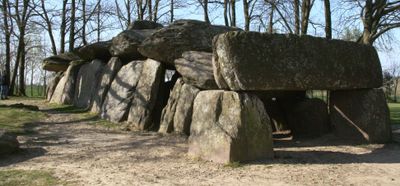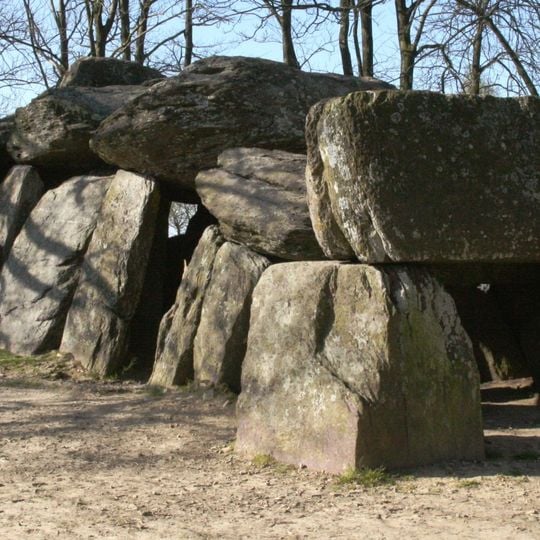
La Roche-aux-Fées, Prehistoric dolmen in Essé, France
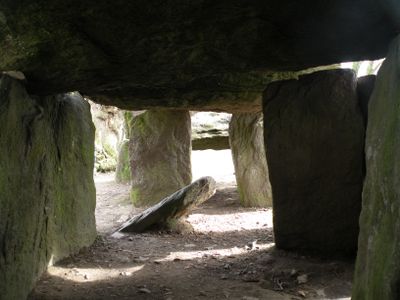
La Roche-aux-Fées is a prehistoric megalithic passage grave comprising two connected burial chambers linked by a covered passage. The structure uses roughly 48 stone blocks arranged across approximately 20 meters of length.
Built between 3000 and 2500 BC, the gallery grave was originally covered by a mound of stones and earth. It was classified as a monument historique in 1840, one of the first thousand protected in France. In 1789 the Orléans dragons regiment reportedly lit a fire inside, damaging the underside of the roof slabs; around 1855 English visitors broke the upper stone of the entrance trilithon.
The name comes from a legend that fairies carried the stones here, a tale often behind the name 'roche aux fées' given to dolmens. In one story collected by Adolphe Orain in 1904, a woodcutter and his wife bury a pot that must not be opened inside the monument in exchange for a purse of gold. Other tales tell of a peasant outwitting a fairy trying to swap a newborn, answering her 'It's me myself', as Odysseus says 'Nobody' to Polyphemus.
The monument stands in open country near the hamlet of la Roche and the Rouvray farm, about 3 km south-southeast of Essé off the D341 towards Retiers. There is no visitor centre; access is limited for wheelchairs. Around 35,000 visitors a year wear down the stone bases, so stay on the paths and keep off the blocks.
The entrance passage aligns with the winter solstice sunrise, casting natural light through the interior on December 21. This alignment suggests the builders possessed a sophisticated understanding of celestial movements.
The community of curious travelers
AroundUs brings together thousands of curated places, local tips, and hidden gems, enriched daily by 93,852 contributors worldwide.