Lac de Bonlieu, lake in France
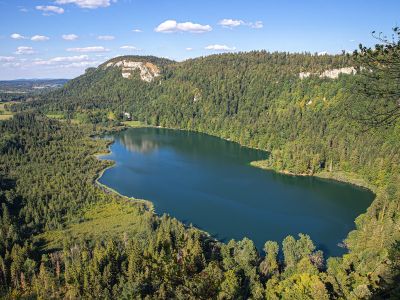
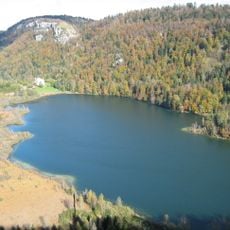
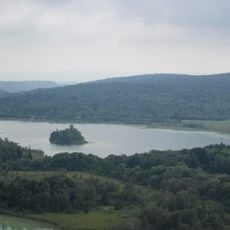
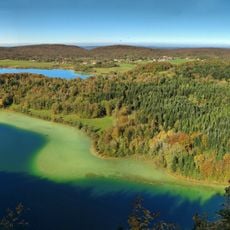
Lac de Bonlieu lies at 791 m in the Jura department, in a synclinal trough between the Pic de l'Aigle anticline and the Champagnole plateau. Its western and southern shores are peat bogs, the northern shore is Hauterivian limestone and marl crossed by the Hérisson, and beech and fir forest surrounds the water. The lake's dark blue colour comes from limestone and marl in the lakebed.
The lake is of glacial origin, fed by underground springs and small streams from the Trémontagne massif, and it serves as the outlet of the Hérisson. Around 1170 Thibert de Montmorot founded a charterhouse on its northern shore; devastated in the Ten Years' War, closed by the Revolution in 1791 and turned into an arms factory, its last buildings were burned by the Nazis in 1944. A hotel, now housing, stands on the site.
The lake takes its name from the commune of Bonlieu. On its northern shore stood a Carthusian monastery founded around 1170 by Thibert de Montmorot; the name survives today in the vocal ensemble Chœur de la Chartreuse de Bonlieu, led by Jean-Paul Montagnier.
The lake lies at 791 m altitude, 2 km southeast of Bonlieu village. It is reached from the north by a walking path; the western and southern shores are peat bogs and the western bank is very marshy and inaccessible. Fishing is practised, with pike caught in the lake.
The lake's dark blue colour comes from limestone and marl in its bed, not from depth. Its western and southern shores are peat bogs, largely impassable, while the northern shore is reached by a walking path through beech and fir forest.
The community of curious travelers
AroundUs brings together thousands of curated places, local tips, and hidden gems, enriched daily by 93,673 contributors worldwide.