Lac de la Maix, Glacial lake in the Vosges Mountains, France.
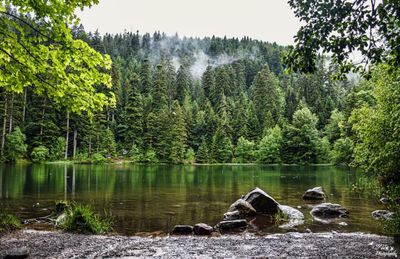
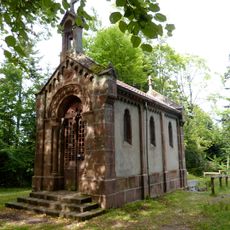
The Lac de la Maix lies in the sandstone Vosges, 3 km from Vexaincourt, on a basin carved by ice about 12,000 years ago. Its still water shows a pale stony bottom near the grassy shore and turns opaque green-blue further out, bordered by dense trees. A stone sarcophagus stands beside the chapel on the bank.
Around 1070 Reignier withdrew to this isolated spot and set up a small church above an underground chapel with the permission of Abbot Bercher of Senones. Bishop Pibon consecrated the sanctuary to the Holy Trinity in May 1090, and the church was enlarged at the end of the 12th century. A stone sarcophagus beside the chapel is carved in the 12th-century manner of Haute-Seille.
The lake's name comes from the Latin meix, a small partitioned domain centred on the hermitage. A legend tells of a fiddler who made villagers dance past the bell for Mass; the ground opened and they drowned in the lake that rose. The chapel is dedicated to the Holy Trinity, and a pilgrimage was held on Trinity Sunday.
The lake lies 3 km from the centre of Vexaincourt, at the south-western end of the Donon massif. The water is fed by springs upstream and its overflow drains away underground rather than over the surface. Willows trail branches more than ten metres into the water, blocking the view from the south and west.
The lake's name comes from the old French "meix", a small partitioned estate whose centre was the sanctuary, chapel, hermitage, gardens, fountain and espalier orchards. A farm called de la Maix stood a few hundred metres away to manage the estate's land. The change from "Mer" to "lac de la Maix" came late, in the 18th century.
The community of curious travelers
AroundUs brings together thousands of curated places, local tips, and hidden gems, enriched daily by 94,657 contributors worldwide.