Gallo-Roman Theatre of Mandeure, Roman theatre in Mandeure, France.
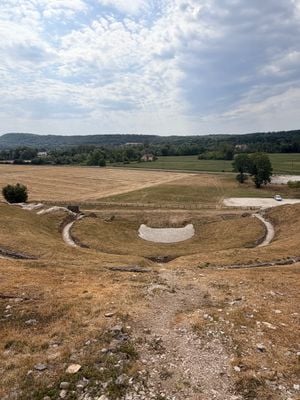
The Gallo-Roman Theatre of Mandeure is a 1st-century structure built into a hillside, with a diameter of 150 m and seating for 15,000 to 18,000. Its curved, crescent-shaped form is made of concentric arcs of low stone walling, with a pale grey outer wall and straight fragments on the right. A flat white paved area shaped like a rounded arch opens onto a straight path leading downward.
The theatre was built in the 1st century in the Gallo-Roman city of Epomanduodurum, contemporary with the Colosseum in Rome. It belonged to a cult complex of over ten hectares facing a sanctuary. Its use ended at an unknown date, and from the 4th century its stone was reused, notably in late-Empire fortifications. The site was identified by Schickhardt in the 17th century, rediscovered in 1819 and excavated from 1820 and again from 1946.
The theatre stood inside the ten-hectare cult complex of the clos du Château, facing a large sanctuary, so gatherings there mixed spectacle with worship. Its name survives through the ancient city of Epomanduodurum, which became Mandeure. Visitors today see the grass-covered arcs of the cavea and the white-paved orchestra.
Access to the theatre is free and available year-round, allowing visitors to explore at their own pace. It is advisable to wear comfortable shoes since the ground is uneven and climbing the stone tiers is part of experiencing the space.
Long thought to lack a stage wall, the theatre was shown by recent excavations to have had a continuous 30-metre-high facade across its diameter, with nine arched bays on each symmetrical wing and a lower, solid central section. A gallery over 50 metres long and 5 metres wide linked it to a building of unknown function.
The community of curious travelers
AroundUs brings together thousands of curated places, local tips, and hidden gems, enriched daily by 94,484 contributors worldwide.