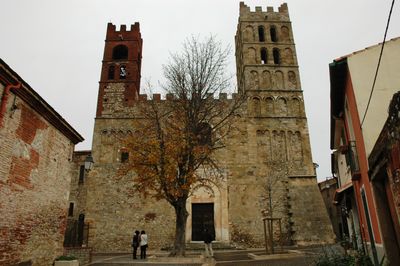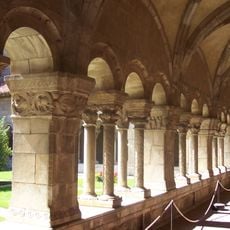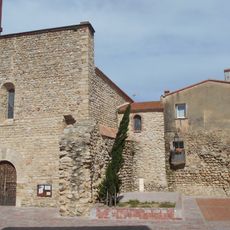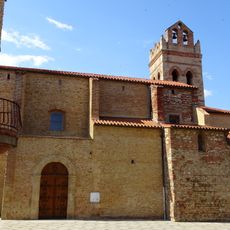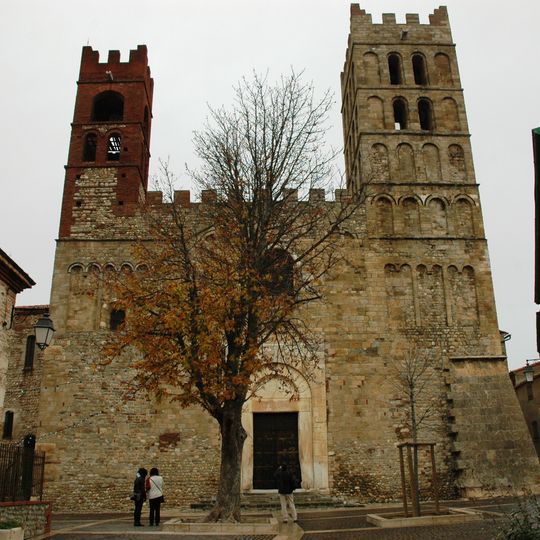
Former Sainte-Eulalie-et-Sainte-Julie cathedral and its cloister, Romanesque cathedral and marble cloister in Elne, France.
The former Sainte-Eulalie-et-Sainte-Julie cathedral is a Romanesque church set on a hill in Elne, in southern France, and one of the oldest religious buildings in the region. It is attached to a cloister built in gray marble veined with blue, whose galleries are lined with carved stone capitals.
The bishopric of Elne is attested from 571, created by the Visigoths, and the present cathedral was begun in the early 11th century; its main altar was consecrated in 1069. In 1285 troops of Philip the Bold set fire to the west door and sacked the building. The bishops obtained permission in 1601 to move their residence to Perpignan, though the see remained at Elne until 1801.
The cathedral is dedicated to Saints Eulalia and Julia, and the west portal in marble still bears burn marks from the fire set by Philip the Bold's troops in 1285. A small room, modelled on a design from Saint Stephen's Cathedral in Toulouse, was used to lock up guilty people for 48 hours until they calmed down.
The building stands on the hilltop upper town and dominates the surrounding plain, so the climb up is part of the visit. The west portal marble still shows fire damage from the 1285 sack, and the cloister, classified as a monument historique since 1840, is entered separately from the church. The nave is very dark, lit mainly by the windows of the Gothic side chapels.
Excavations around the current building have uncovered the remains of the original 6th-century cathedral buried beneath the ground. This means the hill was already a place of worship long before the walls visitors see today were ever built.
The community of curious travelers
AroundUs brings together thousands of curated places, local tips, and hidden gems, enriched daily by 93,972 contributors worldwide.