Saint-Vincent-de-Paul church, Neoclassical Catholic church in the 10th arrondissement of Paris, France
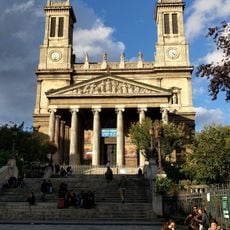
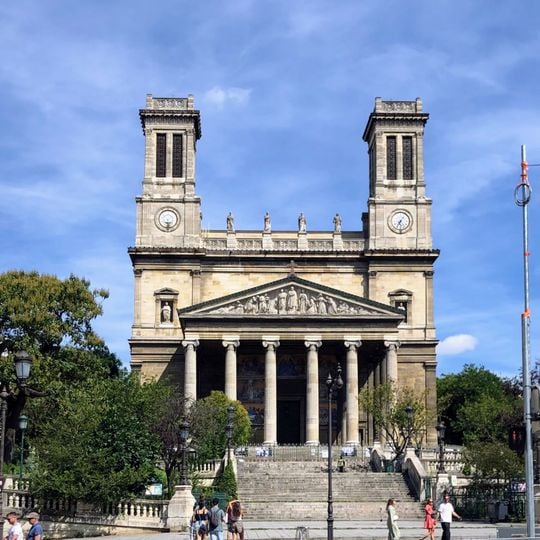
Saint-Vincent-de-Paul church is a Neoclassical building in the 10th arrondissement of Paris, with two square towers topped by clock faces and a central portico of six columns beneath a pediment sculpted by Charles-François Lebœuf-Nanteuil. Inside, two rows of smooth stone columns with plain capitals frame the nave, and a painted frieze of 160 saints by Hippolyte Flandrin runs between the two levels of columns.
The site was a leper colony in the 12th century, then the motherhouse of Saint Vincent de Paul's Congregation of the Mission from 1632 until the Revolution. It became the Saint-Lazare Prison, holding André Chénier, the Marquis de Sade and Mata Hari; its last structures were demolished in 1935. The church was begun in 1824 by Jean-Baptiste Lepère and completed in 1844 by his son-in-law Jacques Hittorff.
The church bears the name of Saint Vincent de Paul, a saint known for helping the poor and sick. The name reflects the social mission that this place has carried out since its founding.
The church stands at the top of a long stairway above Place Franz-Liszt; two horseshoe-shaped ramps, now planted as gardens, lead up to the front and were built so carriages could reach the terrace. The square in front is named after the organ builder Aristide Cavaillé-Coll.
The facade's dark blue-green panels behind the columns are enameled lava plaques painted by Pierre-Jules Jollivet for Hittorff. Their nude figures caused a scandal and were removed in 1861; the seven plaques were restored and reinaugurated on 26 June 2011.
The community of curious travelers
AroundUs brings together thousands of curated places, local tips, and hidden gems, enriched daily by 94,565 contributors worldwide.