Salève, Limestone mountain ridge in Haute-Savoie, France.
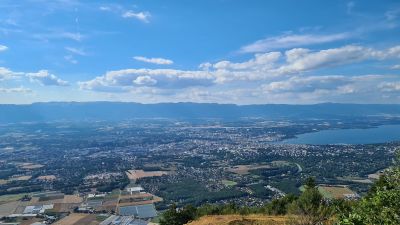
The Salève is a limestone ridge running 21 km from Étrembières in the north to the Pont de la Caille in the south, divided into the Petit Salève (899 m), the Grand Salève (1,309 m) and the Pitons, whose Grand Piton reaches 1,379 m. Its western face above Geneva is a steep wall of pale grey and white limestone in horizontal bands, with narrow ledges and dark green trees and shrubs on the lower slopes, topped by a rounded grassy crest. A second, lower banded outcrop stands to the right, and cultivated fields lie at the foot of the mountain.
An electric rack railway operated on the mountain between 1892 and 1935, representing one of the early modern transport systems in the Alps. This original line was eventually replaced by a cable car system that remains in use today.
The name Salève derives from the Latin salire, meaning to jut out, and the mountain appears as Monte Seleuco in the 4th century. Since 2010 the Tibetan Buddhist centre Shedrub Choekhor Ling has opened its doors to visitors, who can watch monks perform daily rituals and buy handicrafts in the monastery shop.
The mountain is reached by cable car from Étrembières, providing quick access to the summit. Hikers can follow various paths along different sections depending on fitness level and how much time they have available.
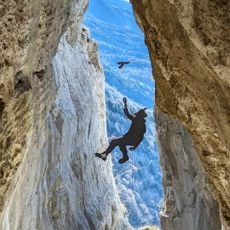
The Grande Varappe, a narrow gorge on the Geneva-facing slope, gave French its term for rock climbing at the end of the 19th century; the sport was developed intensively on these cliffs. Mary Shelley's Frankenstein has the creature scale the overhanging sides of Mont Salève.
The community of curious travelers
AroundUs brings together thousands of curated places, local tips, and hidden gems, enriched daily by 93,562 contributors worldwide.