Abbaye de Buzay, Cistercian abbey ruins in Rouans, France
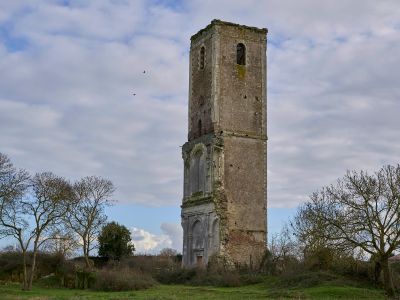
Buzay Abbey is a ruined Cistercian monastery in Rouans, of which only a 33-metre square tower built in 1755 remains, rising from a grassy field. Its weathered masonry shows two arched openings near the top and a pointed-arch niche partly covered by ivy. Vaulted cellars also survive beneath the site.
Bernard of Clairvaux founded Notre-Dame-de-Buzay in 1135 on marshy land given by Conan III at the request of his mother, Ermengarde of Anjou. A dozen monks arrived in 1136 under prior Nivard, Bernard's younger brother. Salt from the Bourgneuf bay and tolls on the Loire made it one of the richest abbeys in Brittany. It was dissolved in 1790 and burned by Royalists in 1795.
The abbey's name comes from the Île de Buzay, the marshy land Ermengarde of Anjou gave to Bernard of Clairvaux. The monks' wealth rested on salt from the Baie de Bourgneuf, tolls on Loire traffic and donated farmland in the Pays de Retz. From Buzay three daughter abbeys were founded: Île du Pilier in 1172, Villeneuve in 1200 and Prières in 1259.
The tower is the primary feature and stands out clearly among the ruins, though underground chambers have limited access. Wear sturdy shoes and bring clothes suited to outdoor conditions, as the site is largely exposed to the elements.
A canal was dug between 1720 and 1775 to connect the monastery with the Loire River for better transport routes. This engineering feat demonstrates how economically vital the site had become to the surrounding region.
The community of curious travelers
AroundUs brings together thousands of curated places, local tips, and hidden gems, enriched daily by 94,363 contributors worldwide.