Royal abbey of Saint-Gildas Saint-Gildas-de-Rhuys, Benedictine abbey in Saint-Gildas-de-Rhuys, Morbihan, France.
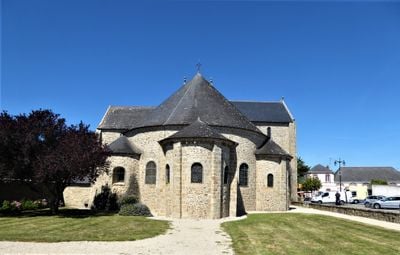
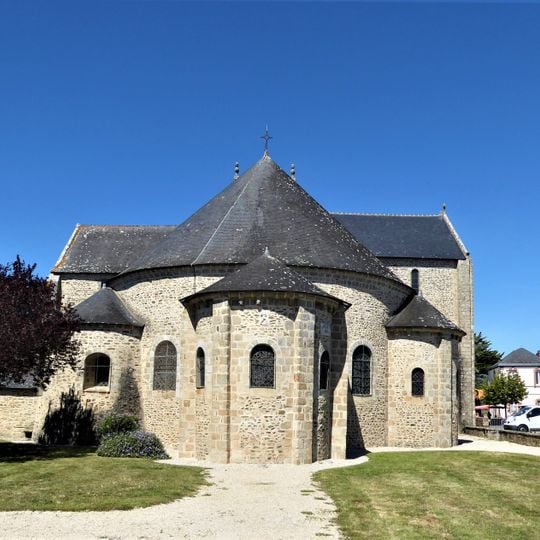
The abbey church of Saint-Gildas is the only remaining building of the Benedictine monastery. Its Romanesque chevet, dating from the late 11th and early 12th centuries, consists of a central apse with a conical roof, surrounded by radiating chapels with round-arched windows. The nave was rebuilt in a neoclassical style after 1699, and the tower was moved to the west facade and completed in 1705.
According to hagiographic legend, Saint Gildas founded the abbey around 538 and led it until his death in 565; it is more likely that monks claiming his relics founded it. In 1008, at the request of Duke Geoffrey I of Brittany, monks from Fleury Abbey led by Saint Felix rebuilt the monastery, which was consecrated on 30 September 1032 by Judicaël, Bishop of Vannes. The surviving Romanesque parts of the church date from the late 11th and early 12th centuries.
The church holds the remains of Breton saints, including Saint Gildas and Saint Goustan, figures whose veneration shaped local religious practice over the centuries. The carved capitals with geometric and plant motifs reveal the craftsmanship monks brought to their everyday surroundings.
The abbey church stands in the village centre on place Monseigneur-Ropert, in the Morbihan department of Brittany. The Romanesque apse and its radiating chapels are the oldest surviving parts; the nave was rebuilt in a neoclassical style after 1699. The church became the parish church in 1802 and the abbey church has been classified as a monument historique since 1840.
The philosopher Pierre Abelard served as abbot from 1125 to 1133 and eventually left after clashing with monks he felt lacked discipline. His time here marked a rare moment when a major medieval thinker directed this place.
The community of curious travelers
AroundUs brings together thousands of curated places, local tips, and hidden gems, enriched daily by 93,530 contributors worldwide.