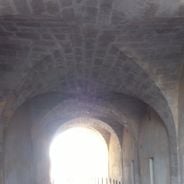
Amphitheatre of Bordeaux, Roman amphitheatre in Bordeaux, France
The amphitheatre of Bordeaux, known as Palais Gallien, is a ruined Roman structure of tiered arches built from small, flat bricks and stone blocks in grey, tan and brown. Its surviving north-west entrance rises as a tall, uneven wall with round-headed arches, and the arena's curve can still be traced in the surrounding streets.
Built at the end of the 1st or in the first half of the 2nd century, as ceramics found in 2010–2012 excavations indicate, the amphitheatre held about 22,000 spectators. A popular tradition says it burned during the Frankish raids of 275–276, but no fire has been proven. It was quarried from the Middle Ages and sold in lots in 1793.
The name Palais Gallien appeared only in 1367, long after the arena was built; medieval tradition linked the ruins to Galliena, said to be a daughter of the king of Toledo and wife of Charlemagne, while a later reading attached it to the emperor Gallienus. Before that the site was called "les Arènes". In the early 17th century it still kept its two axial entrances and a quarter of the cavea.
Access to the archaeological site is possible through rue du Colisée or rue du Dr Albert Barraud, where several bus routes stop nearby. Plan time to view the ruins from different angles to appreciate their scale.
The name "Palais Gallien" only appears in 1367; before that the site was called "les Arènes". Medieval tradition held the ruins to be the palace of Galliena, daughter of the king of Toledo and concubine of Charlemagne, before the name was later attached to the emperor Gallienus.
The community of curious travelers
AroundUs brings together thousands of curated places, local tips, and hidden gems, enriched daily by 93,762 contributors worldwide.