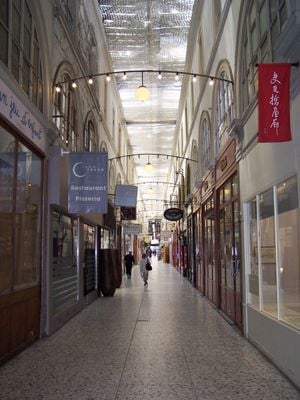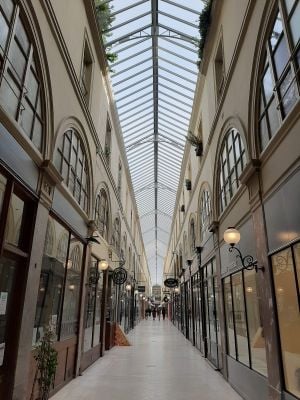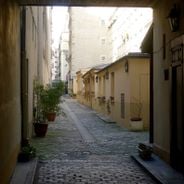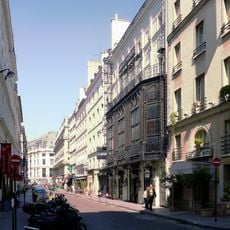
Passage Choiseul, Covered passage in the 2nd arrondissement, Paris, France.
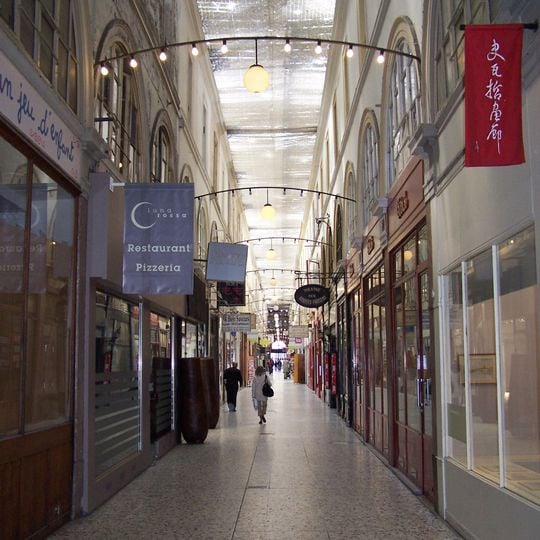
Passage Choiseul is a covered arcade 190 metres long and 3.7 metres wide, running between the rue des Petits-Champs and the rue Saint-Augustin. Its glazed roof is carried on metal arches above rows of shopfronts, and the walls are timber-framed with marble-imitation pilasters from which the ground-floor arcades spring. The upper floors are residential.
The Mallet Bank built the passage between 1826 and 1827 as a speculative development on the site of four hôtels particuliers, including the Hôtel de Gesvres, whose porch still forms the northern entrance. François Mazois drew the plans but died in 1826; Antoine Tavernier completed the work and added the Passage Sainte-Anne. The project was reshaped by the construction of the Opéra-Comique's Salle Ventadour.
The passage takes its name from the Rue de Choiseul, which honours Étienne-François de Choiseul-Beaupré-Stainville, war and foreign minister under Louis XV. The Théâtre des Bouffes-Parisiens, opened in 1857, has its secondary exit at no. 67 and has drawn audiences into the gallery ever since. A historical marker at no. 67 recalls Louis-Ferdinand Céline, whose mother kept a notions shop there.
The passage connects rue des Petits Champs to rue Saint-Augustin and offers clear pathways for walking and exploring. Natural light filters through the glass ceiling, making it easy to navigate and shop comfortably throughout the day.
French writer Louis-Ferdinand Céline spent part of his childhood within this passage and later drew on these memories in his literary works. His personal connection to the place adds a layer of literary history that few visitors know about.
The community of curious travelers
AroundUs brings together thousands of curated places, local tips, and hidden gems, enriched daily by 93,606 contributors worldwide.