Fontaine Louvois, Monumental fountain in Square Louvois, Paris, France
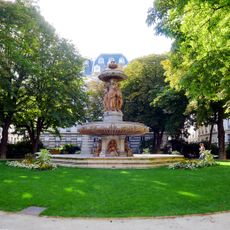
Fontaine Louvois is a monumental stone fountain in Square Louvois, rue Richelieu, in the 2nd arrondissement of Paris. A wide, shallow upper basin rests on a central pedestal, and above it three standing female figures hold a fluted, umbrella-like canopy topped by a finial. Four bronze heads project from the rim below the basin, each spouting a thin stream into a stone-rimmed pool.
Square Louvois was laid out in 1830 on the site of the Opéra de la rue de Richelieu, built in 1792 and demolished in 1820. A chapel begun for the Duke of Berry, stabbed in 1820, was abandoned after the 1830 revolution. The fountain, first called fontaine Richelieu, was built between 1836 and 1839 under Louis-Philippe, designed by Louis Visconti with sculpture by Jean-Baptiste-Jules Klagmann. It was restored in 1859, 1874 and 1974.
The four female statues represent major French rivers and connect the fountain to the country's geography. Visitors can observe how these figures illustrate the link between Paris and the nation's most important waterways.
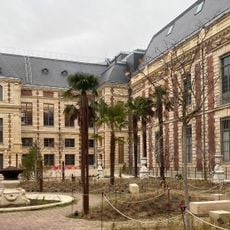
The fountain stands in the middle of Square Louvois, reached from rue Richelieu by the entrance of the Bibliothèque nationale de France. Two named paths, allée Andrée-Jacob and allée Éveline-Garnier, run through the square around it. The square is a public garden, so the fountain can be seen on foot at any time of day.
Twelve carved zodiac signs alternate with water-spouting mascarons around the marble basin rim, creating continuous water flow patterns. This decorative system demonstrates the thoughtful artistic design of 19th-century fountain craftsmanship.
The community of curious travelers
AroundUs brings together thousands of curated places, local tips, and hidden gems, enriched daily by 93,016 contributors worldwide.