Passerelle Eiffel, Railway bridge monument in Bordeaux, France
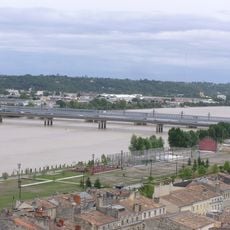
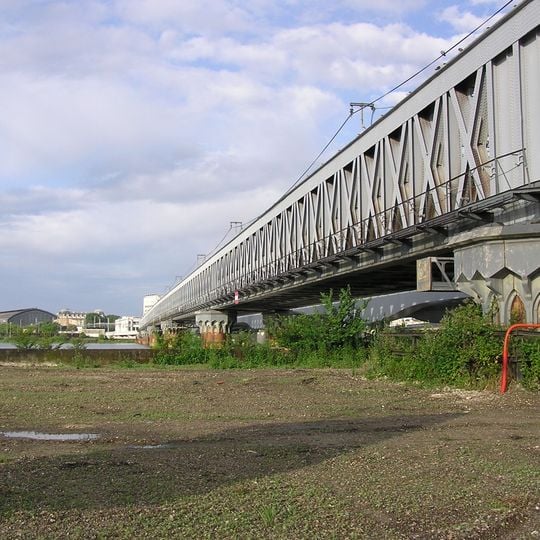
Passerelle Eiffel is a former railway bridge over the Garonne in Bordeaux, built of riveted puddled-iron plates. Its deck, 8.60 metres wide, is carried on two lattice girders 6.35 metres high, braced with tall X-shaped crosses. The span rests on six piers formed of cast-iron tubes 3.60 metres in diameter filled with concrete, sunk to a depth of 17 metres.
The structure was built between 1858 and 1860 and was an early important project of an engineer who became world-famous later. After serving rail traffic for more than 100 years, it was closed in 2008 and given protected status in 2010.
The name "passerelle" was already used for iron structures before this bridge existed, as a plan in the Bordeaux Métropole archives shows; a local legend wrongly links it to the 1862 pedestrian walkway. The bridge linked the Paris–Orléans and Midi networks, ending the carriage transfer between the Orléans and Saint-Jean stations.
The crossing is not open to the public at the moment and is being renovated to eventually allow pedestrians and cyclists. It is wise to check current conditions before planning a visit.
Gustave Eiffel, then 26 and head of works, dived into the Garonne to pull out a worker who had fallen in during construction. He later reused the compressed-air caisson method tried here for the foundations of the Eiffel Tower in 1887.
The community of curious travelers
AroundUs brings together thousands of curated places, local tips, and hidden gems, enriched daily by 93,511 contributors worldwide.