Jardins de la Fontaine, French formal garden in Nîmes, France.
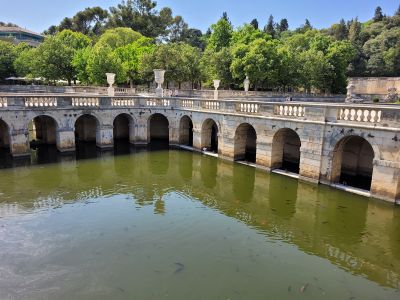
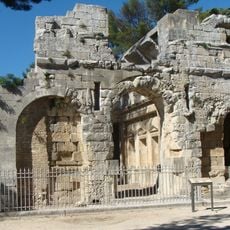
Jardins de la Fontaine is a public park on the slope of Mont Cavalier in Nîmes, laid out around the city's original karst spring. Pale stone terraces, balustrades and stairways step up above the water, with a low round-arched bridge over the channel, statues on pedestals and a single palm on a rectangular lawn. The Temple of Diana and the Tour Magne stand within the grounds.
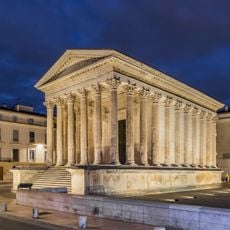
The site was occupied from the Iron Age, from the 6th century BCE, on the slope of Mont Cavalier around a permanent karst spring. In the Gallo-Roman period it held the Augusteum, a vast cult complex of which only the Temple of Diana survives; Pierre Gros identified the remains as an Augusteum in 1984. Jacques Philippe Mareschal laid out the gardens from 1745 under Louis XV, keeping the main lines of the ancient complex. The mills in the canal were demolished in 1742.
The site takes its name from the spring, a permanent karstic source that fed the settlement from the Iron Age, around the 6th century BC. The gardens occupy the ground of the Roman Augusteum, a cult complex of which only the Temple of Diana survives; the water basin was used by washerwomen in 1666, prompting the consul to post a guard and build a washhouse.
You can walk freely through the grounds and should wear comfortable shoes since there are many paths and stairs to explore. The best times to visit are early morning or late afternoon when fewer people are around.
The garden's water comes from a permanent karst spring with an irregular flow, fed by rainwater seeping through the garrigue. In 1724 Henri Gautier noted that the spring's level rose and fell with the Gardon, even without local rain. In 1719, during a drought that dried up private wells, the engineer Jean de Clapiès proposed a 30-inch canal to feed two fountains, a plan never carried out.
The community of curious travelers
AroundUs brings together thousands of curated places, local tips, and hidden gems, enriched daily by 93,597 contributors worldwide.