Église Notre-Dame-du-Fort d'Étampes, Romanesque church in Étampes, France
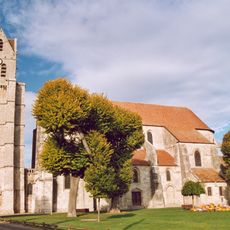
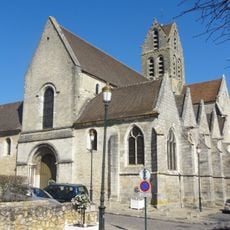
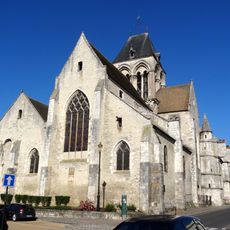
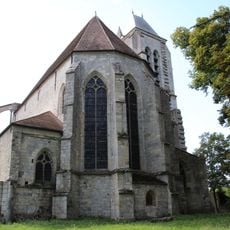
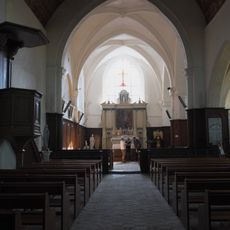
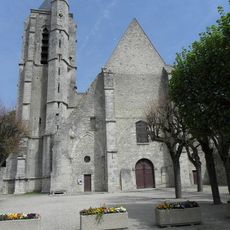
Église Notre-Dame-du-Fort is a parish church on the left bank of the Juine in central Étampes, built mainly between 1130 and 1210 in a late Romanesque style with early Gothic elements. Its plan is irregular, with a two-bay nave, aisles, a double transept and a three-bay choir ending in a flat wall. The 11th-century crypt under the choir has three aisles on six columns. The bell tower rises in three stages, the two lower square with paired arched openings, the third octagonal with a stone spire.
The building took its main form in the 12th century, though its origins trace back to 1022. Major modifications and fortifications were added through the 13th century, responding to changing needs over time.
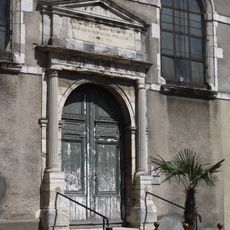
The south portal, carved around 1150, has three statues on each side of the doorway, identified as the Sibyl, Moses and Solomon on the left and Aaron, David and the Queen of Sheba on the right. The heads were struck off in 1562 during the Wars of Religion, and traces of the original paint were found during restoration. The tympanum shows Christ ascending between two angels.
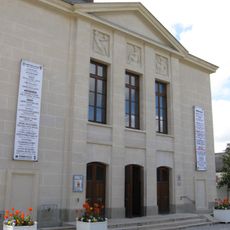
The church stands in a dense urban block on rue de la République, with no square to step back from; only a narrow triangular parvis fronts the west facade. The south portal on rue de la République is the most remarkable element, and the rue du cloître Notre-Dame runs around the north and east sides, widening into a small square north of the north transept. The crypt lies under the choir.
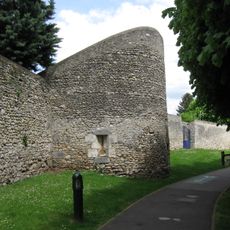
In the 13th century, the church was reinforced with crenellated walls and parapets to defend against regional conflicts. These defensive features give the sacred building an unexpected fortified appearance, revealing its role as both a place of worship and a refuge.
The community of curious travelers
AroundUs brings together thousands of curated places, local tips, and hidden gems, enriched daily by 94,608 contributors worldwide.