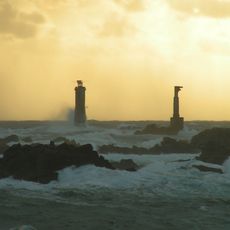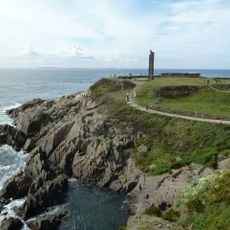
Pierres Noires lighthouse, Maritime lighthouse in Le Conquet, France.
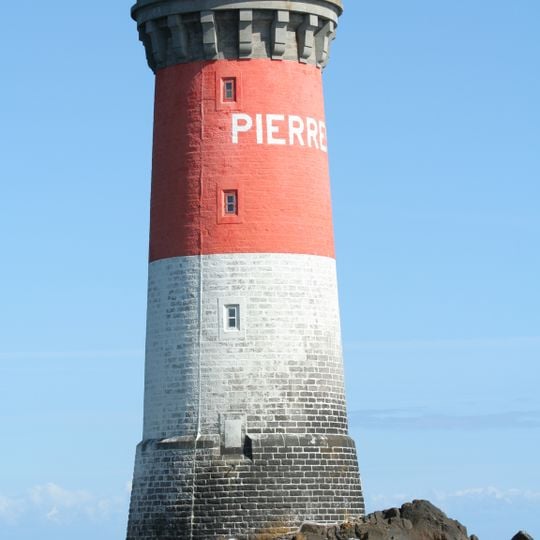
Pierres Noires lighthouse is a cylindrical stone tower built in three colour bands: dark grey blocks at the wider footing, rough light grey stone with a small rectangular window in the middle, and a red upper section bearing the white letters "PIERRE" between two small square windows. A projecting grey stone gallery with vertical supports and a flat rim tops the tower. It is built of Aber-Ildut and Kersanton granite.
The construction project was approved on 2 July 1862 and the ministry's go-ahead signed on 3 May 1865, with a budget of 325,000 gold francs. Engineer Victor Fénoux designed the tower, built from 1867 to 1871 and inaugurated on 1 May 1872. The corvette Gorgone had been wrecked on the Pierres Noires reef on 18 December 1869, drowning 93 crew, and the light was meant to keep ships clear of those rocks. It was listed as a monument historique on 31 December 2015 and classified on 20 April 2017.
The tower's red band carries the name "PIERRE" in white capitals, a detail visible from passing vessels. The light flashes red every five seconds and is visible 360 degrees, reaching 20 nautical miles; in fog a horn sounds two blasts every 60 seconds. Since 1992 the lighthouse has been automated and is remotely controlled from the Phare du Créac'h on Ouessant.
The tower stands offshore on the Chaussée des Pierres Noires, so it is not reached on foot and has no visitor access; it is automated and remotely controlled from the Créac'h lighthouse on Ouessant. It is seen at a distance from the coast near the pointe Saint-Mathieu, in the commune of Le Conquet. In fog, its foghorn sounds two blasts every 60 seconds.
The dark rocks that give this lighthouse its name are submerged at high tide and visible only during low tide. These hidden formations had caused numerous shipwrecks before the tower was built to warn mariners.
The community of curious travelers
AroundUs brings together thousands of curated places, local tips, and hidden gems, enriched daily by 94,657 contributors worldwide.