Abbadia Castle, Observatory castle in Hendaye, France.
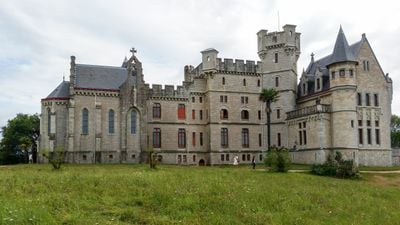
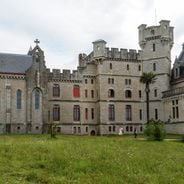
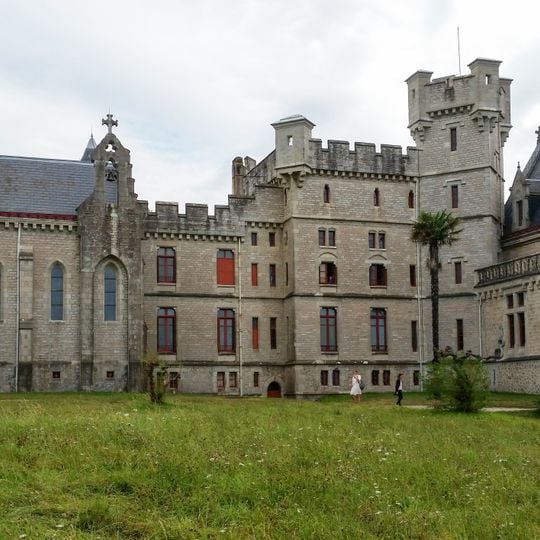
Abbadia Castle is a Neo-Gothic building of light grey stone on the Basque corniche, with an irregular outline: a steep dark roof and a pointed gable topped by a stone cross on the left, flat crenellated parapets in the centre, and a square tower with a pyramidal cap and corner turrets on the right. A round turret with a conical dark roof stands at the front of the taller block. The observatory occupies the northwestern corner, reached through a small square tower.
Antoine d'Abbadie, born in Dublin in 1810 to a Basque father and Irish mother, spent a dozen years in Abyssinia before settling at Urrugne in 1849. He commissioned the castle in 1857; after Clément Parent's 1859 plan seemed too Renaissance, Auguste Magne began work in 1864. Viollet-le-Duc, short of time, entrusted the neo-Gothic design to his pupil Edmond Duthoit; the wings were roofed in 1865 and the building completed in 1879.
Antoine d'Abbadie, nicknamed Euskaldunen Aita (Father of the Basques), had Basque inscriptions placed in the castle and kept archives there. From 1851 he organized Basque festivals and competitions in poetry, pelota, irrintzina and livestock at Urrugne. The interior decoration draws on his travels in Abyssinia and Egypt.
Visitors need to reserve in advance to see inside the castle, as entry is only by guided tour. The tours are conducted in French, though information materials in other languages are available at the entrance.
The observatory's meridian telescope looks out through shutter openings in the walls, and the observatory itself is reached by a small square tower at the building's northwestern corner. The first circular observatory, built in 1858, was later demolished and replaced by the current rectangular structure.
The community of curious travelers
AroundUs brings together thousands of curated places, local tips, and hidden gems, enriched daily by 94,657 contributors worldwide.