Belfry of Abbeville, Belfry in Abbeville, France
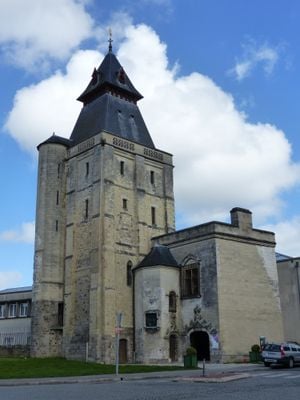
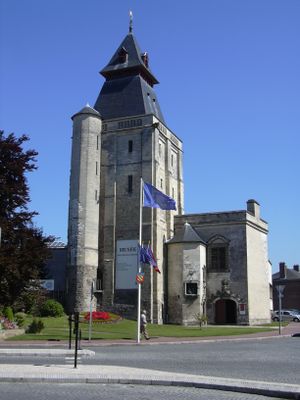
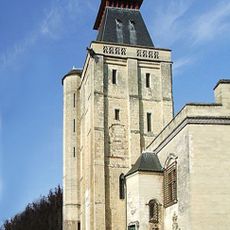
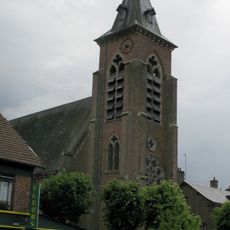
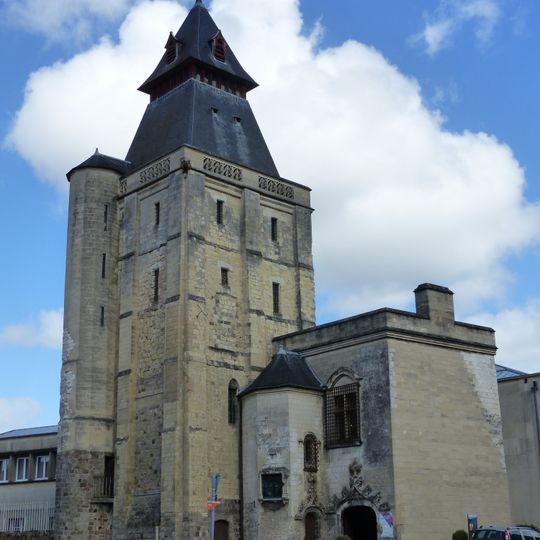
The Belfry of Abbeville is a square tower of regular sandstone rubble, 27 m high and 10 m on each side, with walls 2.30 m thick at the base and 1.60 m at the top. Flat buttresses one metre wide stand at each corner and mid-face, and a 15th-century polygonal stair turret adjoins the north side. The pyramidal roof is topped by a timber bell-cote with a weathervane of the Count of Ponthieu on horseback.
Construction of this belfry began in 1209, marking it as one of the earliest towers of this kind built in northern France to display municipal authority. World War II bombing badly damaged the structure in 1940, destroying the medieval roof, though later restoration in 1986 brought it back.
The tower has housed the Musée Boucher-de-Perthes since 1954. The museum's entrance is the 15th-century Gothic trésorerie built against the belfry in 1468, where the town's archives were once kept. Inside, a room that served the échevins as council chamber and courtroom can be seen, along with the old cells and the treasury room that held the communal charter, treasure and seal.
Entry to the belfry happens only with a guide who will lead you through the tower and its museum floors at set times. Reaching the upper levels involves climbing many stairs, so wear comfortable shoes and expect a physically demanding visit.
The belfry's outer wall carries a bronze bas-relief by Emmanuel Fontaine, inaugurated in 1887, commemorating Enguerrand Ringois, an Abbeville man thrown from Dover Castle into the sea in 1368 for refusing to swear loyalty to King Edward III of England.
The community of curious travelers
AroundUs brings together thousands of curated places, local tips, and hidden gems, enriched daily by 94,657 contributors worldwide.