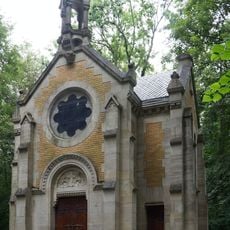
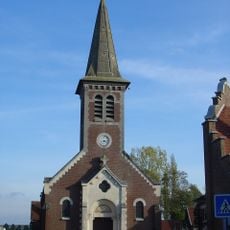
Vis-en-Artois Memorial, War memorial in Vis-en-Artois, France
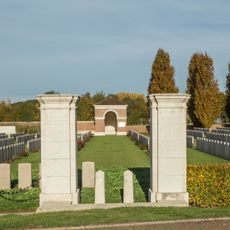
The Vis-en-Artois Memorial consists of a wall carved with names of fallen soldiers divided into three sections. Tall columns flank either side of this structure, forming part of a larger cemetery complex dedicated to those who died.
The memorial was designed by architect J. R. Truelove with sculpture by Ernest Gillick, and unveiled on 4 August 1930 by Thomas Shaw, then British Secretary of State for War, with General Walter Braithwaite also present. It commemorates 9,843 British and South African soldiers with no known grave who fell in the Advance to Victory between 8 August 1918 and the Armistice. It is maintained by the Commonwealth War Graves Commission.
The names are carved by regiment, and the memorial also records men who served under aliases, such as Sergeant R. L. Addison, listed as George Abbott of the London Regiment. Five soldiers named here were 17 when killed, among them Albert George Paddock of the South Wales Borderers. Private Frederick Charles Butcher of The Buffs was executed for cowardice on 27 August 1918, aged 26.
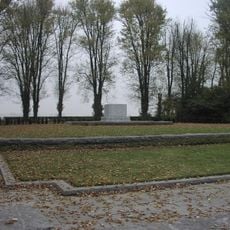
The memorial stands within the Vis-en-Artois British Cemetery at Haucourt, reached by road from the Vis-en-Artois area; a short staircase climbs to the raised terrace holding the Stone of Remembrance. The names are carved across twelve panels in the screen wall, so allow time to move along the panels and the flanking colonnades.
Among the 9,843 names carved on the panels are those of five soldiers who were 17 when they died, including Albert George Paddock of the South Wales Borderers and Stanley Morton of the Duke of Wellington's Regiment. Eight men are recorded under aliases, such as Jack Hibberd, who served as Jack Kirby in the Royal Field Artillery.
The community of curious travelers
AroundUs brings together thousands of curated places, local tips, and hidden gems, enriched daily by 94,434 contributors worldwide.