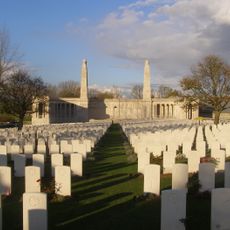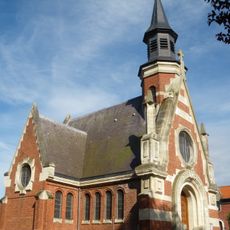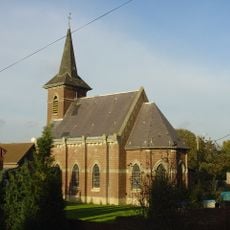
Monchy-le-Preux Memorial, War memorial at Monchy-le-Preux, France.
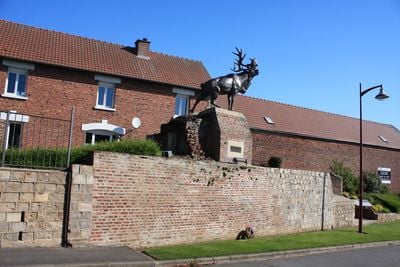
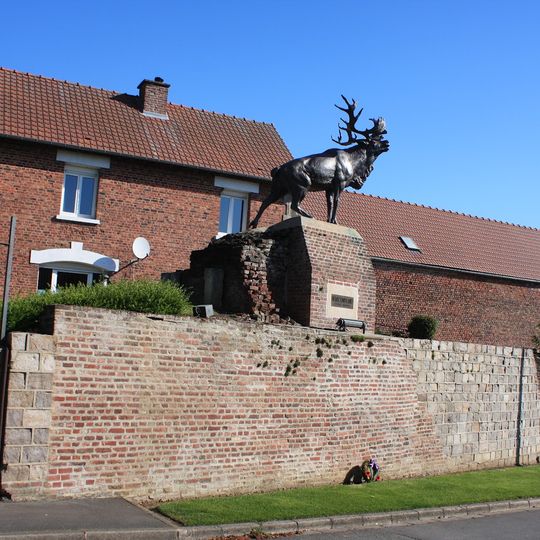
The Monchy-le-Preux Memorial centres on British sculptor Basil Gotto's bronze caribou, the emblem of the Royal Newfoundland Regiment, mounted on the ruins of a former German bunker in the middle of the village. The animal faces Infantry Hill, the ground from which the regiment withstood the German attack. It stands on the north side of Rue de la Chaussy, about 30 m west of the D33.
The memorial marks the fighting of 14 April 1917, when the Royal Newfoundland Regiment and the 1st Essex Battalion attacked Infantry Hill east of the village during the Battle of Arras. Both units were surrounded and crushed by a German counterattack. Lieutenant-Colonel James Forbes-Robertson then led about twenty men to a shallow ditch on the village edge, where ten held off the Germans for 11 hours until relieved after dark. Newfoundland casualties at Monchy numbered 460.
The caribou is the emblem of the Royal Newfoundland Regiment, and the Monchy-le-Preux statue is one of six that the Newfoundland government erected in Europe after the First World War. The others stand at Beaumont-Hamel, Gueudecourt and Masnières in France, at Courtrai/Kortrijk in Belgium and at Gallipoli; a seventh was given to Bowring Park in St. John's.
The memorial stands in the centre of the village, on the north side of Rue de la Chaussy, about 30 m (100 ft) west of the D33. It is a roadside monument rather than a hilltop site, so it can be reached on foot from the surrounding streets.
Unlike the other five Newfoundland battlefield memorials in Europe, which stand on cairns of Newfoundland granite, this caribou is mounted on the ruins of a German bunker. The animal faces Infantry Hill, the ground from which the German attack came in April 1917.
The community of curious travelers
AroundUs brings together thousands of curated places, local tips, and hidden gems, enriched daily by 93,356 contributors worldwide.