Palais de Justice de Périgueux, Neoclassical courthouse in Périgueux, France
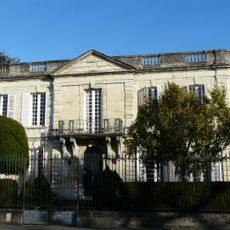
The Palais de Justice is a neoclassical courthouse built of stone from the quarries of Prompsault and Les Izards, measuring 56 metres long and 30 metres wide. Its tetrastyle portico with Ionic columns is modelled on the Temple of Athena Nike in Athens, and the building's rooflines reveal a cross-shaped interior plan.
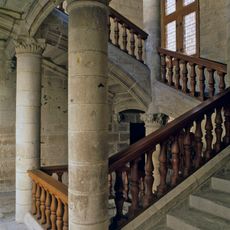
Architect Louis Catoire presented plans in 1827 for a new courthouse to replace the civil and criminal courts beside the town hall on Place du Coderc. Construction ran from 1829 to 1839 on the edge of the Cours des Princes, now Boulevard Michel-Montaigne. In 1997 the facades, roofs, peristyle, vestibule, staircase and Salle des Pas-Perdus were partially listed as monuments historiques.
The courthouse hears cases of the Périgueux tribunal de grande instance and the Dordogne cour d'assises. Its name, Palais de Justice, is carved in the band beneath the pediment, above the four Ionic columns of the portico. A wrought-iron gate installed in 2001 closes the peristyle when the building is shut.
The courthouse stands at 19 bis boulevard Michel-Montaigne, on the outer edge of Périgueux's protected sector, a short walk from the historic centre. The portico faces the boulevard, so the four-columned front and its inscription can be read from the pavement. A wrought-iron gate closes the peristyle when the building is shut.
The tetrastyle portico is modelled on the Temple of Athena Nike on the Acropolis of Athens. The building was erected with stone from the Prompsault quarries at Notre-Dame-de-Sanilhac and the Izards quarries at Chamiers, south of Périgueux. In 2001 an iron gate was fitted so the peristyle can be closed when the court is shut.
The community of curious travelers
AroundUs brings together thousands of curated places, local tips, and hidden gems, enriched daily by 94,020 contributors worldwide.