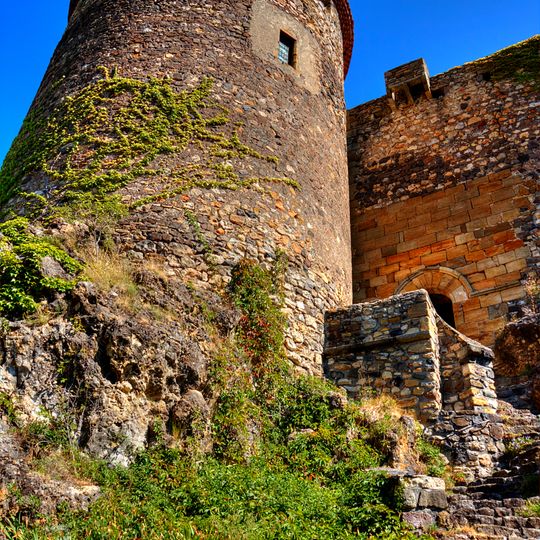
Château de Busséol, Medieval fortress in Busséol, France
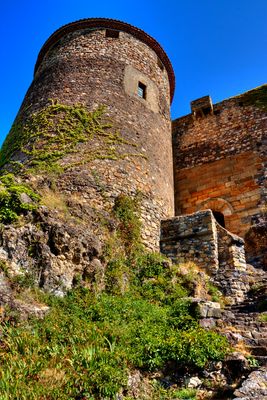
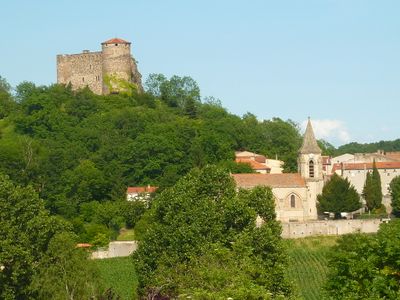
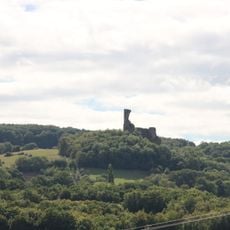
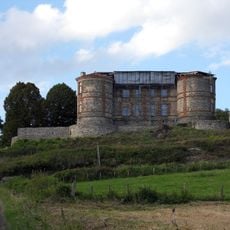
Château de Busséol is a medieval fortress perched on a volcanic peak in the Auvergne region, rising above the surrounding landscape. The structure features a central keep with thick walls and crenellations characteristic of medieval defensive architecture.
The castle's existence is attested in 833, when the Carolingian king Pepin I confirmed privileges to the abbey of Manglieu granted by Charlemagne. The present fortress was built in 1170 by William VIII of Aquitaine, who gave it to Pope Alexander III and the Church. It withstood sieges by Philip Augustus in 1215, the Black Prince's soldiers in the Hundred Years' War, and Jean-Louis de La Rochefoucauld in 1589.
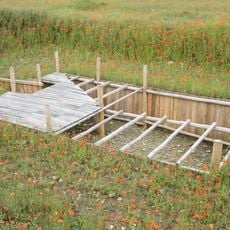
The castle's name may come from the Latin buteo, a buzzard, referring to birds of prey nesting on the volcanic rock. Inside, the great hall is named for the Order of Saint Lazarus of Jerusalem, whose protectors were the counts of Auvergne during the Crusades. The reconstructed Garden of the Crusades replays medieval plantings of vegetables, fruit trees, Mediterranean flowers and medicinal herbs.
The visit follows a winding stone stairway along the west side, between the rock face and the keep, up to a small Romanesque entrance portal of warm-coloured hard stone. The climb is steep and the path uneven, so wear sturdy shoes and allow extra time in wet weather. The castle is private but open to visitors.
The great hall holds a 12th-century circular open hearth with a conical hood, set into the room rather than against a wall. The keep rises 27 metres in two storeys, with walls three metres thick and an interior diameter of five metres. The Garden of the Crusades replants the medieval terraces with vegetables, fruit trees, Mediterranean flowers and medicinal herbs.
The community of curious travelers
AroundUs brings together thousands of curated places, local tips, and hidden gems, enriched daily by 94,564 contributors worldwide.