Baume Abbey, Benedictine abbey in Baume-les-Messieurs, France
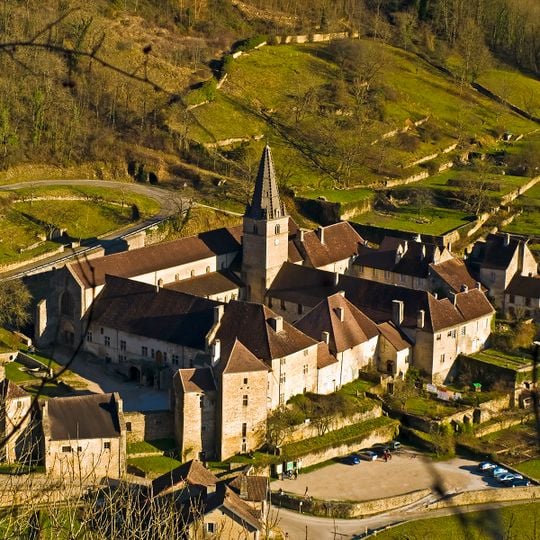
Baume Abbey is a monastery complex built from stone structures near the source of the Dard River in eastern France's Jura region. The site comprises residential areas, outbuildings, and the church arranged together to form a connected whole that developed over many centuries.
Baume is first attested in 869 as a cella dependent on Château-Chalon, and was refounded around 890 under Abbot Berno, who left in 909–910 to found Cluny. Reduced to a Cluniac priory in 1147, it was ruined in 1336 and rebuilt by abbots Amé de Chalon and Henri de Salins. It was secularised in 1753 and its canons expelled in 1790.
The abbey church of Saint-Pierre holds a sixteenth-century retable, the work the site is best known for. The monks were called Baume-les-Moines until the eighteenth century; the village became Baume-les-Messieurs after the canons were expelled in 1790. The name Baume comes from the Latin balma, a cave or rock shelter, referring to the surrounding cliffs.
Guided tours are available from April through September, while the outer courtyards remain accessible year-round. Visitors should be prepared for uneven terrain and stairs within the historic structures.
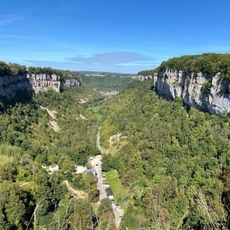
The abbey stands at the confluence of the Dard, which rises at the Grottes de Baume, and the Seille, in a narrow glacial valley cut into the first Jura plateau. The site is a reculée, a blind valley closed by cliffs, and the village has long since crowded against the abbey walls.
The community of curious travelers
AroundUs brings together thousands of curated places, local tips, and hidden gems, enriched daily by 94,365 contributors worldwide.