Retable, Renaissance altarpiece in Baume-les-Messieurs Abbey, France
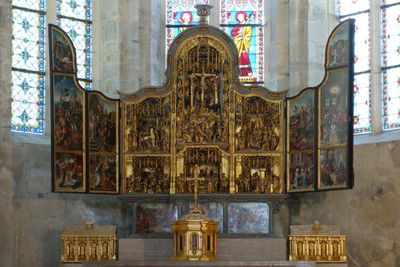
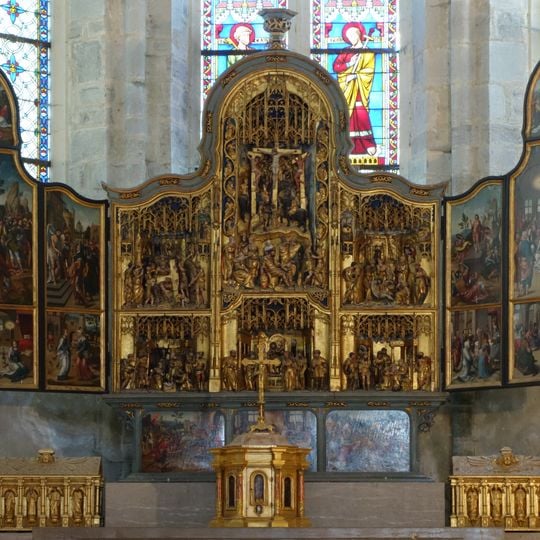
The Retable de Baume-les-Messieurs is a large gilded wooden triptych on the high altar of the abbey church. Its central section rises above the wings under an arched canopy, with carved and painted panels framed in gold. The central panel shows the Crucifixion; the open wings depict Christ's childhood and Passion, and the predella carries painted scenes. A small gilded domed tabernacle with a cross stands in front.
The earliest documented record of this altarpiece dates to 1702, when it was mentioned as a gift from the University of Ghent to Abbot Guillaume de Poupet. It was crafted in Flanders during the 1530s before eventually arriving at the French abbey.
When closed, the triptych shows Christ's public life and miracles; opened, it shows his childhood and Passion. Old Testament scenes are set beside the Passion as prefigurations: Melchizedek offering bread and wine and the manna above the predella announce the Eucharist, and the Tree of Jesse frames the Crucifixion.
The altarpiece stands on the high altar at the far end of the abbey church's apse, a position it has held since Abbot Jean de Watteville reorganised the choir in the 17th century. Look for the gilded domed tabernacle bearing the abbey's arms on the ledge before it. The 1994-1995 restoration stabilised the structure and cleaned the polychromy.
The altarpiece retains most of its original sculptured figures, making it one of the best-preserved examples of Flemish religious art from that period. This level of completeness is uncommon since many comparable works from the era suffered damage or loss.
The community of curious travelers
AroundUs brings together thousands of curated places, local tips, and hidden gems, enriched daily by 92,993 contributors worldwide.