Vieux pont de Limay, Medieval bridge in Limay, France
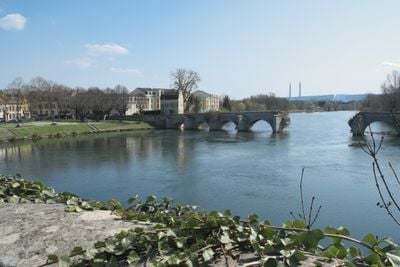
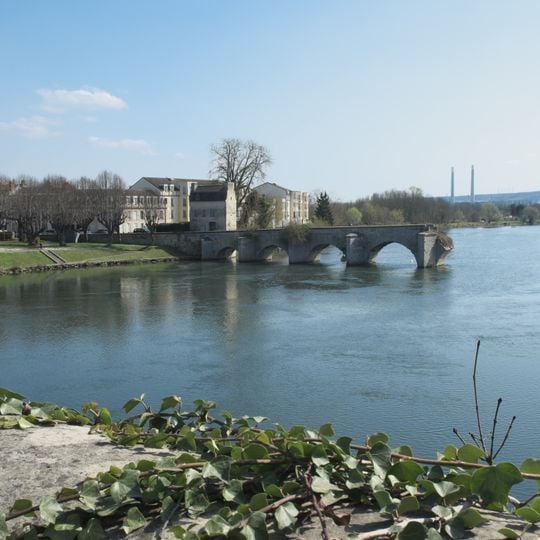
The Vieux pont de Limay carries a stone deck on light grey and tan masonry across the Limay arm of the Seine, from Limay to the Île aux Dames. Four rounded arches are visible in the surviving span, the nearest wider than the rest, with a solid parapet along the top. Two isolated piers with cutwaters and remnants of parapet stand in the water where the central arches were blown in 1940; the 12th-century pointed arch is the oldest surviving trace.
A charter of 1050 is the earliest document mentioning a bridge between Mantes and Limay. The structure was almost entirely destroyed in 1162 and rebuilt in 1172; the pointed arch of the 12th century is the last trace of that period. Of the eleven arches, two central ones were blown up by French military engineers in 1940 and never rebuilt.
Camille Corot painted the bridge several times in the 19th century; his Pont de Mantes (1868) hangs in the Louvre. Maurice de Vlaminck also painted it around 1900. The bridge appears in the penultimate scene of François Truffaut's film Jules et Jim.
The bridge is easy to reach on foot from both banks of the Seine, and information panels along the riverside help with orientation. Walking along the promenades on either side gives a good view of the structure from multiple angles.
In medieval times, mills were built directly on top of the bridge, so the same structure served as both a crossing and a production site. This kind of dual use was common in medieval Europe and shows how closely trade was tied to river crossings.
The community of curious travelers
AroundUs brings together thousands of curated places, local tips, and hidden gems, enriched daily by 93,602 contributors worldwide.