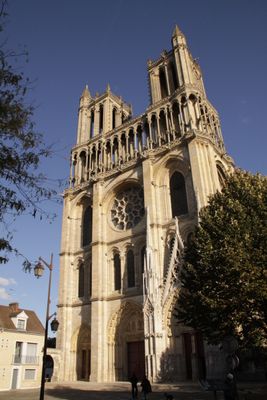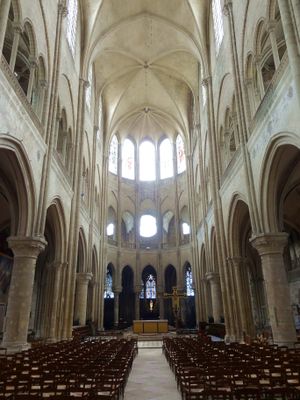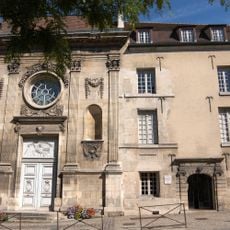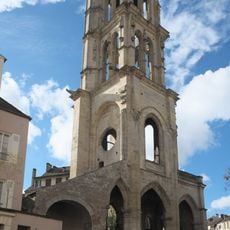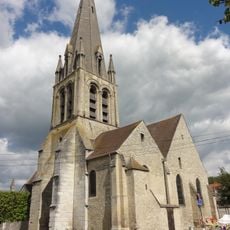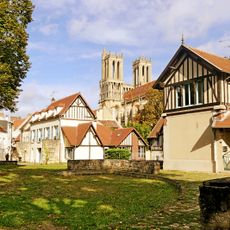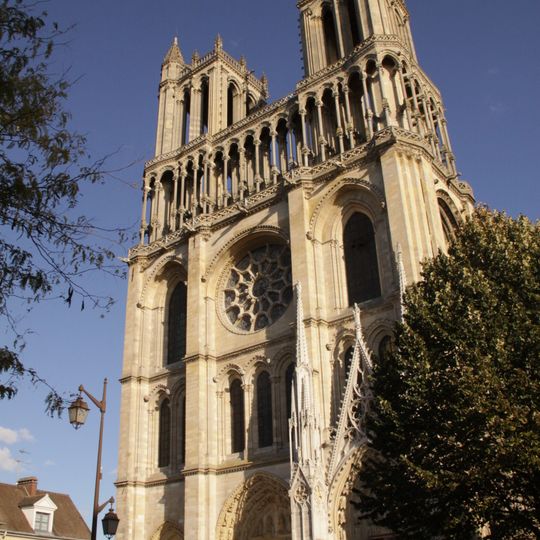
Notre Dame de Mantes, Gothic church in Mantes-la-Jolie, France.
Notre Dame de Mantes is a Gothic church on the Seine in Mantes-la-Jolie, distinguished by three grand portals and twin towers on its western side. The interior extends approximately 67 meters in length and houses a vaulted ceiling with notable height properties.
Construction of the present church began between 1155 and 1170, funded by the commune and the Crown, and continued in campaigns into the 14th century. The north tower was finished around 1266, its upper stage rebuilt from 1492 to 1508 after a collapse. Sacked during the Revolution and turned into a saltpetre works and arsenal, it was classified as a Monument historique in 1840; Alphonse Durand rebuilt the north tower from 1851 to 1855.
The west facade keeps two 12th-century portals: the left one (c. 1170) shows the Resurrection with the Quem quaeritis? scene, the central one the Death, Assumption and Coronation of the Virgin. The central portal was badly damaged during the Revolution; some mutilated statues found by Alphonse Durand in the foundations of the old Ursuline convent are now shown at the Musée de l'Hôtel-Dieu.
The church stands on a bluff above a bend of the Seine, so it is seen best when approached from the north or east. Look for the putlog holes pocking the exterior walls, left where the medieval builders fixed their scaffolding. The north face was restored in 2012.
The gallery vaults are the church's oddest feature: pointed transverse tunnel vaults pierced by large round oculi, a system found nowhere else in France, with a comparable example only in William of Sens' choir gallery at Canterbury. In the 14th century eight bays were rebuilt with ordinary quadripartite vaults and pointed windows, and those bays are visibly lighter than the untouched ones.
The community of curious travelers
AroundUs brings together thousands of curated places, local tips, and hidden gems, enriched daily by 94,114 contributors worldwide.