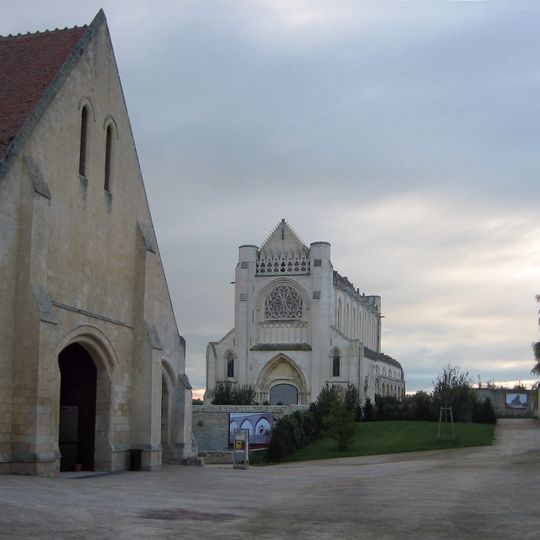
Ardenne Abbey, Gothic abbey in Saint-Germain-la-Blanche-Herbe, France.
Ardenne Abbey is a former Premonstratensian abbey near Caen, in Saint-Germain-la-Blanche-Herbe. Its preserved Gothic buildings in pale limestone include a tall gabled structure with a pointed-arch doorway and, to its right, the church facade with a rose window and a pierced arcade in the gable. The church and other buildings are protected as historic monuments.
Founded around 1121 as a priory by the Caen bourgeois Ayulphe du Marché and his wife Asseline, the community was attached to La Lucerne Abbey in 1144, entering the Premonstratensian order, and became an independent abbey in 1160. In 1230 the choir collapsed, killing 26 canons including abbot Nicolas, which reshaped the abbey's plan.
The abbey is now occupied by the Institut mémoires de l'édition contemporaine (IMEC), an archive of contemporary publishing. The site's name comes from the plot called "le puits aux Saxons" where the first chapel was built. The abbey church, refurnished by the English Unitarian William Russell, held the first Protestant service in France since the Revolution in October 1801.
The abbey lies at Saint-Germain-la-Blanche-Herbe, a few kilometres west of Caen, and is occupied by the Institute of Contemporary Publishing Archives, so access to the buildings depends on the institute's reading and exhibition arrangements rather than on parish use. The church, cloister and Saint-Norbert gate stand within the walled complex; visitors should arrange any visit in advance with the institute.
In June 1944, eighteen Canadian soldiers were executed at the abbey by members of the 12th SS Panzer Division Hitlerjugend; evidence showed they were shot in the back of the head. The event is known as the Ardenne Abbey massacre.
The community of curious travelers
AroundUs brings together thousands of curated places, local tips, and hidden gems, enriched daily by 94,458 contributors worldwide.