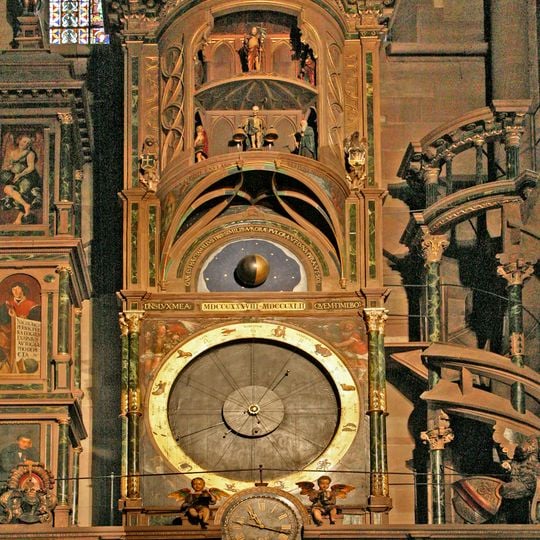
Strasbourg astronomical clock, Astronomical clock in Cathedral of Our Lady of Strasbourg, France
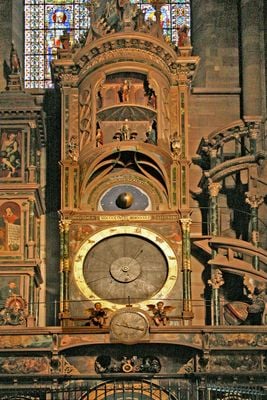
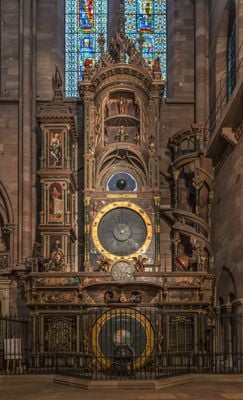
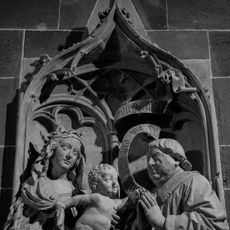
The Strasbourg astronomical clock stands in the south transept of Notre-Dame Cathedral, a multi-tiered structure of sandstone and wood against the wall. Its large circular dial has a black center, gold ring and Roman numerals, flanked by two seated figures, with a smaller clock face below. Above sits a blue starry sphere; the upper tiers frame small sculpted figures under a curved canopy.
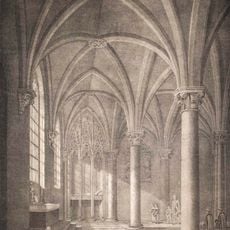
A first clock, showing the Three Kings, was built between 1352 and 1354 by an unknown maker and dismantled in 1572–74. The second clock, designed by Christian Herlin and completed by Conrad Dasypodius with the Habrecht brothers and Tobias Stimmer in 1574, stopped around 1788. Jean-Baptiste Schwilgué replaced its mechanisms between 1838 and 1843, keeping the 16th-century case.
The clock's rooster, a gilded automaton from the first 14th-century clock, crows three times at solar noon while the Apostles pass before Christ. The figures of the Apostles were added only in Schwilgué's 1843 version; the earlier clocks had a rooster but no Apostles, so the crowing does not reenact Peter's denial.
The apostles move at 12:30 daily, and the rooster crows three times; the quarter-hour figures with Death run all day. The clock stands high on the south transept wall, so stand back in the nave to see the upper tiers. The gold hands show mean solar time, the silver hands public time.
The mechanism contains a system that automatically calculates the Easter date without requiring manual adjustments for centuries ahead. This perpetual calculation is a feature rarely found in other timepieces of its era.
The community of curious travelers
AroundUs brings together thousands of curated places, local tips, and hidden gems, enriched daily by 94,046 contributors worldwide.