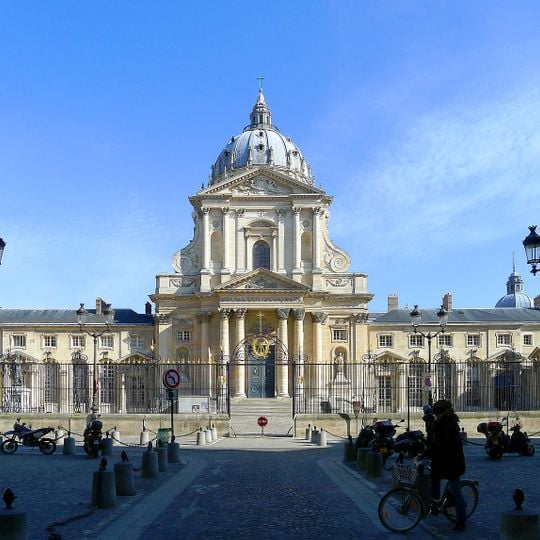
Église du Val-de-Grâce, Baroque church in 5th arrondissement, France
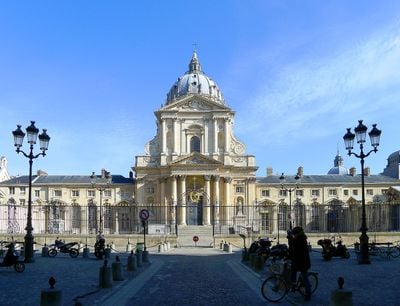
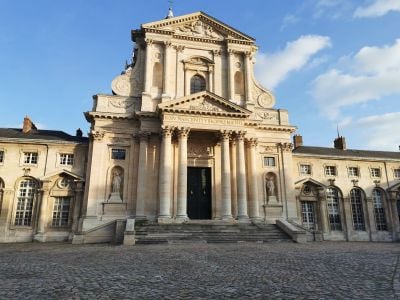
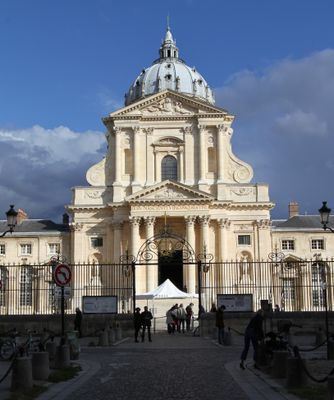
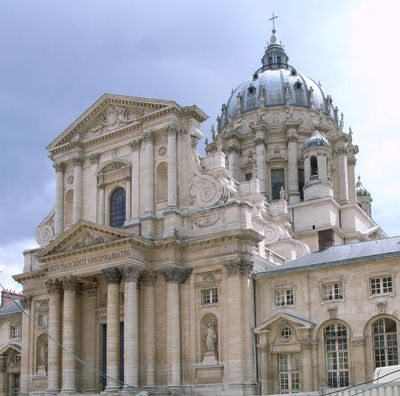
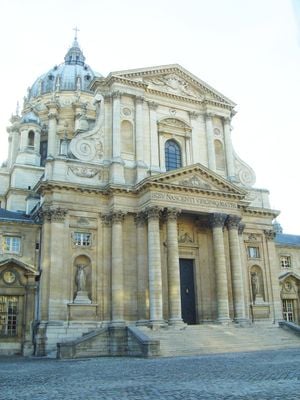
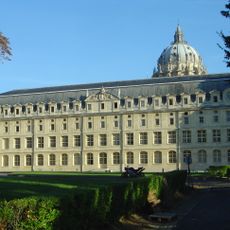
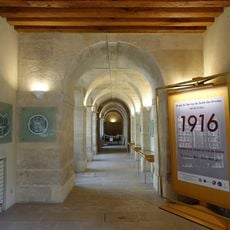
The Église du Val-de-Grâce is a baroque church in the 5th arrondissement of Paris featuring a two-story façade with paired columns supporting a triangular pediment. The interior combines religious spaces with a military medical museum and displays richly ornamented architectural details throughout.
Anne of Austria commissioned the church's construction in 1645 as a votive offering following the birth of her son Louis XIV after many years without children. The building became an expression of royal gratitude and a major religious monument of its time.
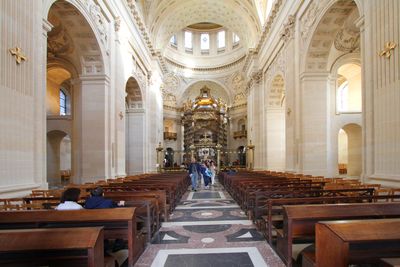
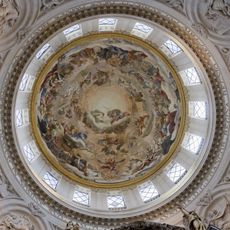
The dome's interior displays frescoes by Pierre Mignard illustrating The Glory of the Blessed, while the baldachin draws design inspiration from Saint Peter's Basilica in Rome. These artistic elements remain central to how visitors experience the sacred space today.
This location welcomes visitors for regular religious services and operates as a military medicine museum. It is helpful to check opening hours beforehand, as both functions may affect when you can explore the space.
The Aristide Cavaillé-Coll organ was installed in 1853 and remains one of the few surviving historical organs in Paris still used for concerts. Music lovers appreciate this instrument for its distinctive sound and its continued role in Paris's musical life.
Location: 5th arrondissement of Paris
Inception: 1667
Founders: Anne of Austria
Architects: François Mansart, Jacques Lemercier, Pierre Le Muet, Gabriel Le Duc
Architectural style: baroque architecture
Address: 1, place Alphonse Laveran, 75005 Paris
GPS coordinates: 48.84056,2.34194
Latest update: December 6, 2025 16:02
Paris has a collection of remarkable domed buildings that shaped the city's skyline and define how Parisians move through their urban spaces. These structures, built over several centuries, tell the story of how architects learned to cover large areas with glass and metal, creating spaces filled with natural light from above. From grand exhibition halls to religious monuments, from government buildings to shopping destinations, these domes showcase different approaches to the same architectural challenge: how to let light flood into a building while supporting a large roof. The Grand Palais stands as one of the most recognizable examples. Completed in 1900 for the Paris Exposition, this massive building features a glass dome made of metal and iron that rises above the Champs-Elysees. When you walk through it, light pours down from above, creating an open, soaring feeling inside. Today it hosts major art exhibitions and cultural events, drawing crowds who come to see both the shows and the building itself. The dome is so prominent that you can spot it from many points across the city. Other domes throughout Paris tell equally compelling stories. The Pantheon crowns a hilltop in the Latin Quarter with its neoclassical design. Napoleon's tomb sits beneath the Dôme des Invalides, a gold-tipped dome visible from across the Seine. The Sorbonne's dome anchors the university quarter, while the Bourse de commerce, Galeries Lafayette, and Le Printemps department stores brought these architectural forms into the commercial heart of the city. Each dome reflects the era in which it was built and the purpose it was meant to serve, yet together they create a visual thread connecting different neighborhoods and different aspects of Parisian life.
The Latin Quarter is one of the oldest parts of Paris and preserves traces from over two thousand years of history. Roman remains like the Arènes de Lutèce recall the ancient settlement of Lutetia, while medieval churches such as Saint-Étienne-du-Mont and Saint-Julien-le-Pauvre document the religious past. The Sorbonne and the Collège de France have made the district a center of learning since the Middle Ages, and institutions like the Bibliothèque Sainte-Geneviève continue this academic tradition. The Musée de l'Histoire de la Médecine traces the development of medicine, the Musée Curie honors the scientific discoveries of Marie and Pierre Curie, and the Musée des Arts du Moyen Âge displays medieval art within the ruins of Roman baths. Narrow streets lead to squares like Place de la Contrescarpe and Place de l'Estrapade, where locals gather in cafés and markets. The Marché de la Rue Mouffetard is one of the city's oldest street markets and offers fresh produce daily. Literary and artistic traces appear at the Maison de Serge Gainsbourg, the historic jazz cellar Le Caveau de la Huchette, and cafés like Le Procope, which has welcomed writers and thinkers since the 17th century. The Jardin des Plantes combines botanical collections with the Musée de Minéralogie, while the Square René-Viviani provides a quiet view of Notre-Dame with its ancient tree. The Grande Mosquée de Paris and the Institut du Monde Arabe add North African and Arab perspectives to the cultural offerings.
Port-Royal Abbey
328 m
National Institute of Deaf Youth of Paris
310 m
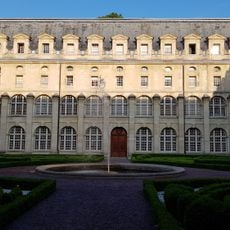
Cloister of Val-de-Grâce
86 m
Fontaine de l'Observatoire
380 m
Église Saint-Jacques-du-Haut-Pas
343 m
Couvent des Feuillantines
153 m
Couvent des Ursulines de Paris
232 m
Musée du service de santé des armées
43 m
Église évangélique Saint-Marcel
188 m
Saint Edmund's Priory
119 m
Commanderie Saint-Jacques du Haut-Pas
312 m
Museum of the Armed Forces Health Service
58 m
Cochin hospital chapel
262 m
Église de l'abbaye de Port-Royal de Paris
316 m
Fresco of the cupola of the church of Val-de-Grâce by Pierre Mignard
3 m
275 rue Saint-Jacques
84 m
277 rue Saint-Jacques
81 m
Hôtel du 6 rue du Val-de-Grâce
126 m
Garden of the Institute of Young Deaf
334 m
Monument to Charles-Michel de l'Épée
298 m
273 rue Saint-Jacques, Paris
92 m
271 rue Saint-Jacques, Paris
99 m
Crous de Paris
332 m
Maison du sculpteur Rude
275 m
Pavillon sud bordant la cour d'honneur de l'abbaye du Val-de-Grâce
77 m
Cloître de l'abbaye de Port-Royal de Paris
342 m
Buffet d'orgue (Paris 5e arrondissement)
343 m
Hôtel de Longueville
131 mVisited this place? Tap the stars to rate it and share your experience / photos with the community! Try now! You can cancel it anytime.
Discover hidden gems everywhere you go!
From secret cafés to breathtaking viewpoints, skip the crowded tourist spots and find places that match your style. Our app makes it easy with voice search, smart filtering, route optimization, and insider tips from travelers worldwide. Download now for the complete mobile experience.
A unique approach to discovering new places❞
— Le Figaro
All the places worth exploring❞
— France Info
A tailor-made excursion in just a few clicks❞
— 20 Minutes