Salines de Salins-les-Bains, Historical saltworks in Salins-les-Bains, France.
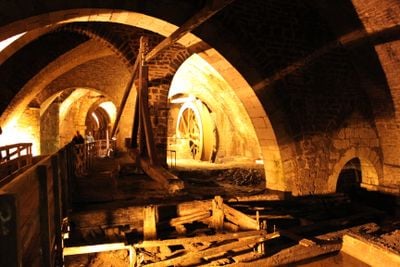
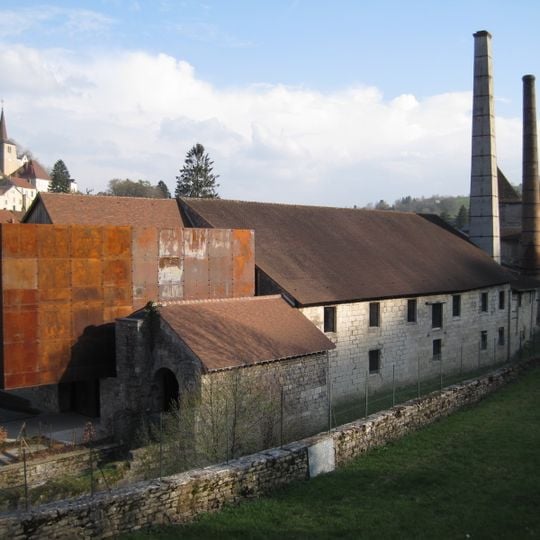
Salines de Salins-les-Bains is a historic salt production site in France where underground galleries, natural springs, and evaporation halls worked together to extract and process salt from saline water. The buildings and structures show how workers managed water flows, heated brine, and crystallized salt using methods that lasted for centuries.
Salt was already extracted at Salins in the Neolithic period, and a document of 791 mentions the saline. In the Middle Ages the Grande Saline, shared among about a hundred rentiers, was almost entirely acquired by the counts of Burgundy in 1237; it yielded 3,000 tonnes of salt a year, half the duchy's profits from the Comté. Closed in 1962, it has belonged to the municipality since 1966 and was inscribed by UNESCO in 2009 alongside Arc-et-Senans.
Salt production shaped how this place looks and how people lived here for centuries, influencing the buildings, streets, and daily rhythms of the town. You can still see how homes and workshops were organized around the salt springs, showing how central this craft was to community life.
You can visit year-round as the underground galleries stay at a steady temperature, making conditions comfortable in any season. Wear sturdy shoes since the paths can be uneven and floors are damp in the tunnels, so watch your footing.
The brine reached Arc-et-Senans through a 21-kilometre saumoduc, a brine conduit laid between the two sites, not an underground pipeline in the modern sense. It carried the salt water from Salins to the boilers of the Royal Saltworks, which operated from 1779 until 1895.
The community of curious travelers
AroundUs brings together thousands of curated places, local tips, and hidden gems, enriched daily by 95,351 contributors worldwide.