Fort Belin, Military fortification in Salins-les-Bains, France.
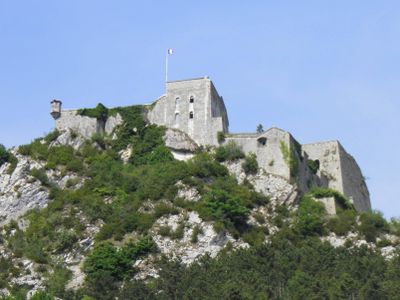
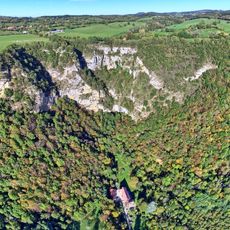
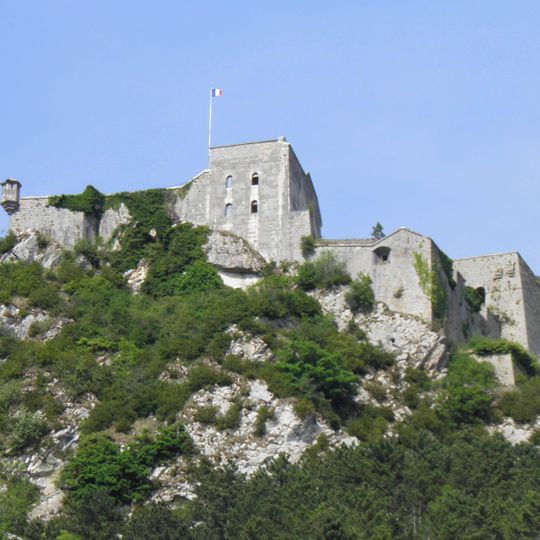
Fort Belin stands on a steep rocky hill above Salins-les-Bains, its light grey stone walls rising from pale rock with vegetation growing on the masonry. A tall central block with a flat roofline and narrow vertical openings carries a flagpole; to the left a lower wall ends in a small turret, to the right a slightly lower section has an arched opening and a small window. The fort is divided by a moat, its south part serving as a reduit, and is surrounded by a moat, a caponnière and a counterscarp gallery.
The fort was reconstructed after the Austrian siege of 1814 and transformed into a casemate structure in 1828. This modernization made it a more effective defensive position for its era.
The fort's name recalls the medieval Chastel Belin that stood here, shown in ruins in a 1628 painting. Below the site, halfway down the slope, was a hermitage dedicated to Saint Anatoile, later replaced by the fort de l'Ermitage. The fort has also drawn filmmakers: scenes from Yves Boisset's Radio Corbeau (1989) and Jacques Doillon's Trop (peu) d'amour (1998) were shot here.
The fort is currently in private ownership, with ongoing restoration work to maintain its structure. Visitors should check availability in advance since accessibility may vary due to ongoing conservation efforts.
The optical telegraph post built after 1871 in the ruins of a medieval tower beside the redoubt signalled by light beams to Besançon (Fort de Montfaucon), Pontarlier (Fort du Larmont supérieur) and Dijon (Fort de la Motte-Giron). A crenellated communication wall linked the redoubt to the main fort.
The community of curious travelers
AroundUs brings together thousands of curated places, local tips, and hidden gems, enriched daily by 93,478 contributors worldwide.