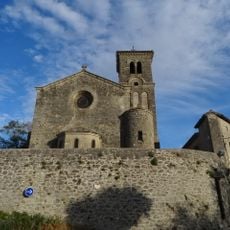
Église abbatiale, Benedictine abbey in Saint-Hilaire, Aude, France
The abbey church of Saint-Hilaire is a 12th-century Romanesque building with a semicircular apse lit by three windows whose 19th-century stained glass was made by Louis-Victor Gesta's workshop. Its nave has three bays with rib vaults dating from the 13th century. The west facade was never completed and is closed by a stone wall.
The first written record of this abbey dates to 825, when it was originally dedicated to Saint Saturnin before receiving Saint Hilaire's relics in 970. This transfer of holy remains marked a major shift in the site's importance and reputation.
The abbey was first dedicated to Saint Saturnin, first bishop of Toulouse, before the relics of Saint Hilaire were transferred there in 970 under Abbot Benoît, in the presence of Count Roger I of Carcassonne. The village and the abbey still bear the name of Carcassonne's first bishop, who evangelised the Carcassès in the 6th century.
The abbey stands between Limoux and Carcassonne in the Aude. The chapter house is now closed off, with only its twin round-arched window and walled-up doorway visible. The monks' refectory, restored in 2005-2006, hosts exhibitions, lectures and concerts. The cloister is a listed monument since 1846.
The monks' 1531 discovery is tied to the cellars cut into the rock beneath the abbey, where the adjoining vaults were used for winemaking. The abbey's own vineyards supplied the grapes, and the drink took its name from the nearby town of Limoux.
The community of curious travelers
AroundUs brings together thousands of curated places, local tips, and hidden gems, enriched daily by 94,657 contributors worldwide.