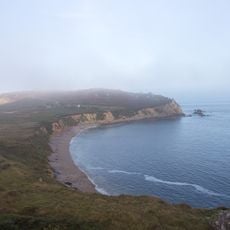
Alignement de Lagatjar, Prehistoric stone row in Camaret-sur-Mer, France
Alignement de Lagatjar consists of more than 80 standing stones arranged in parallel rows across an open coastal hillside. The menhirs vary in height and size, with some reaching three meters, and they form distinct linear patterns across the landscape.
The site originates from the Neolithic period and was originally built with several hundred stones erected over thousands of years. Official protection came in 1883 when authorities recognized its importance as an ancient monument.
The site's name comes from Breton Lagad-Yar, 'hen's eye', also recorded as Toull-Inguet or Toulinguet. In 1908 Commandant Alfred Devoir read the rows as a 'bi-solsticial' monument, one axis tied to the winter solstice, the other to the summer solstice. In 1927-1928 the poet Saint-Pol-Roux, who lived at the nearby manoir de Cœcilian, spoke at the inauguration after restoration.
The site is open year-round without entrance fees or advance reservations needed. Walking across the hillside is straightforward, though sturdy shoes are advisable and visitors should note the exposed location on the coastal ridge.
The site was classified as a monument historique on 18 June 1883, yet Paul du Châtellier reported in 1907 that quarrymen were still removing stones and only 80 remained. The rows were re-erected in 1927-1928 under Bénard Le Pontois and the architect Gaston Chabal, and the poet Saint-Pol-Roux, who lived at the nearby manoir de Cœcilian, spoke at the inauguration.
The community of curious travelers
AroundUs brings together thousands of curated places, local tips, and hidden gems, enriched daily by 94,657 contributors worldwide.