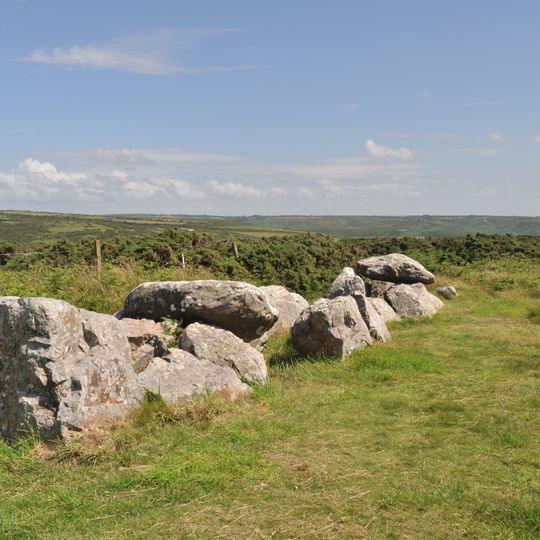
Pierres pouquelées de Vauville, Passage grave in La Hague, France
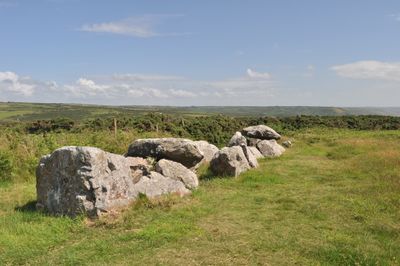
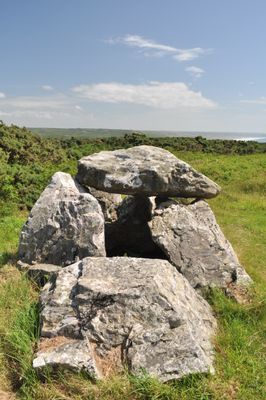
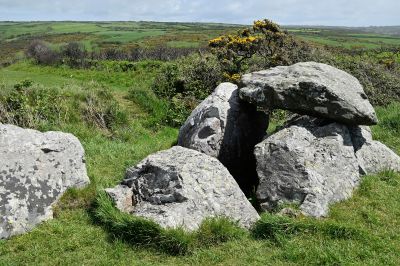
The allée couverte de Vauville is a Neolithic passage grave built on a hilltop in La Hague, in the Normandy region of France. It consists of upright stone slabs made mostly of siliceous sandstone forming a long, narrow gallery about 14.5 meters (roughly 47 feet) long, with an entrance on the southwest side and two cover stones made of granodiorite.
The allée couverte de Vauville was built around 4,500 years ago to serve as a collective burial site for a Neolithic community. In the early 19th century, locals removed several stones to build a bridge, causing serious damage to the structure before it was granted protected status as a classified historical monument in 1907.
The orientation of the Vauville passage grave, running northwest to southeast, follows a pattern seen at many megalithic sites of that era, possibly linked to the observation of the sun's movement. Visitors who walk along the stones can notice this alignment themselves by looking toward the horizon at either end.
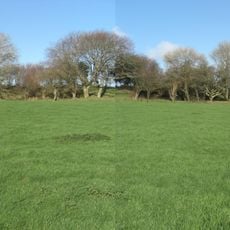
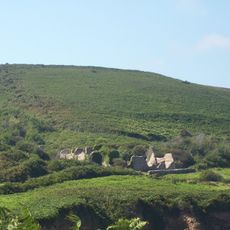
The site sits on a hilltop and is reached on foot, so sturdy footwear is a good idea as the ground can be uneven. Since the monument is in the open air, visiting in dry weather makes the walk and the visit more comfortable.
The two cover stones of the monument are made of granodiorite and were brought from a source roughly 3 kilometers away, while the side slabs are of local quartzite sandstone. This deliberate choice of two different rock types shows that the builders made a clear distinction between the materials they used for different parts of the structure.
The community of curious travelers
AroundUs brings together thousands of curated places, local tips, and hidden gems, enriched daily by 91,685 contributors worldwide.