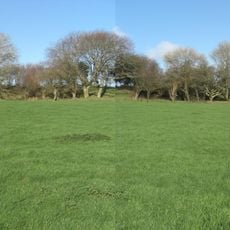
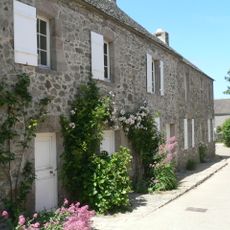
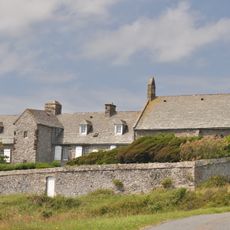
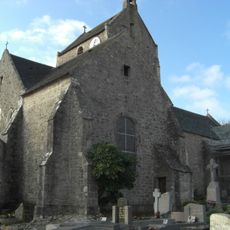
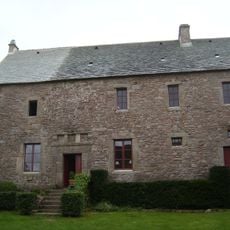
Manoir de Dur-Écu, 16th-century manor estate in Urville-Nacqueville, France.
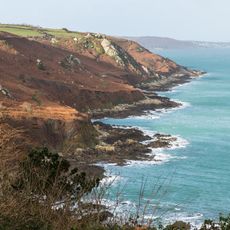
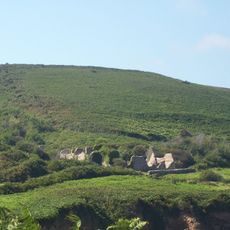
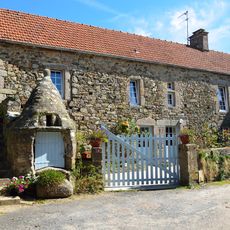
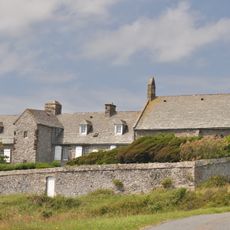
The Manoir de Dur-Écu is a fortified manor below a wooded hill above the sea, 1.5 km west of Urville-Nacqueville. Its narrow logis sits between two round corner towers with pepper-pot roofs, with a raised ground floor and mullioned windows. A high tower crowned with machicolations and a thin stair turret stands beside it, and a massive low round dovecote with fine dormers completes the group.
Dur-Écu is a fortified dwelling of the 14th century, rebuilt in the 16th after the Hundred Years' War on older foundations. In 1595 it belonged to Jean Heuzé, sieur de Gréville and Urville; around 1600 Thomas Lesdos, bailli of the abbey of Le Vœu and supporter of Henri IV, styled himself sieur de Dur-Écu. Uninhabited in the 18th century, restored in the 19th, it was ravaged by fire in June 1944 during bombing of a nearby German listening post, then restored over 50 years by the René-Bazin family, who still own it.
The manor house shows Norman traditions through its preserved features, including the original pigeon house on the grounds. The layout demonstrates how residents once integrated farming and animal husbandry with daily life at the estate.
The manor stands 1.5 km west of Urville-Nacqueville on the coastal road of La Hague, at the foot of a wooded hill above the sea. The site opens from July to September and during the Journées du Patrimoine. The former water mills have been converted into gîtes for overnight stays.
The property holds both historical monument status and natural site protection, a dual classification that is uncommon in France. This dual designation protects both the historic structures and the natural features of the surrounding La Hague landscape.
The community of curious travelers
AroundUs brings together thousands of curated places, local tips, and hidden gems, enriched daily by 93,365 contributors worldwide.