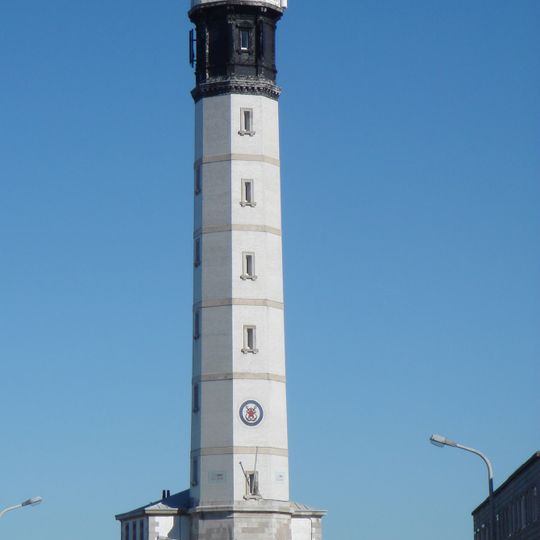
Calais Lighthouse, Historical lighthouse in Calais, France
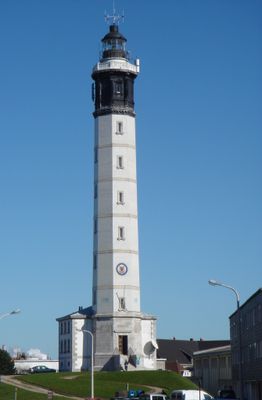
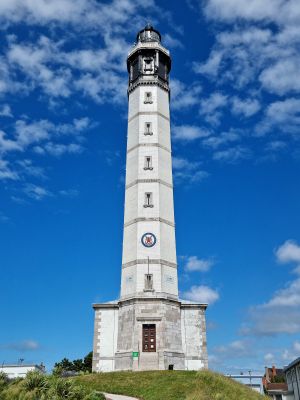
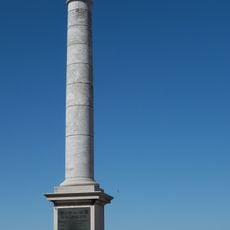
Calais Lighthouse is a 53-metre tower, octagonal outside and round inside, with walls 1.90 m thick at the base and 1.50 m at the top. Its white shaft, banded and pierced by five small windows, rises from a squared stone base to a black cylindrical lantern. It stands among residential streets near the Port of Calais.
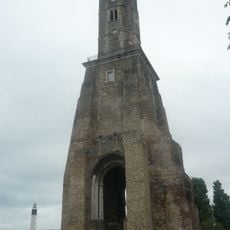
A beacon burned atop the 13th-century Tour du Guet before this lighthouse was built. King Louis-Philippe ordered a first-class lighthouse for Calais, and it entered service in 1848, designed by architect Léonce Reynaud. It was electrified in 1883, damaged in the Second World War when its lantern room was destroyed, automated in 1987, and classified as a monument historique on 19 April 2011.
The tower stands in a residential neighbourhood near the Port of Calais, an unusual position for a lighthouse; in France only those of Dunkerque, Ouistreham and La Rochelle are similarly urban. It replaced the 13th-century Tour du Guet, on whose summit a fire was lit to guide sailors. It has been a classified monument historique since 19 April 2011.
The lantern is reached by a staircase of 271 steps, and the tower stands in residential streets near the Port of Calais rather than on the waterfront. The walls measure 1.90 m at the base and 1.50 m at the top, so the climb narrows as it rises. Technicians of the phares et balises, not a resident keeper, now maintain it.
The lantern's panels rotate around a fixed central light, so the beam itself never turns: four flashes of 0.2 seconds each every 15 seconds. The tower stands 53 m high, with walls 1.90 m thick at the base and 1.50 m at the top, on foundations sunk 7.40 m below the cellars.
The community of curious travelers
AroundUs brings together thousands of curated places, local tips, and hidden gems, enriched daily by 93,483 contributors worldwide.