Citadelle de Calais, 16th-century citadel in Calais, France
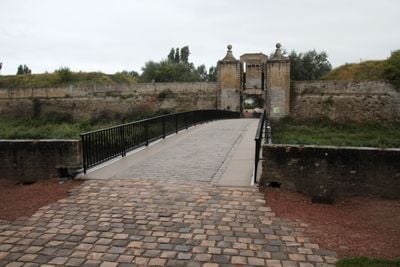
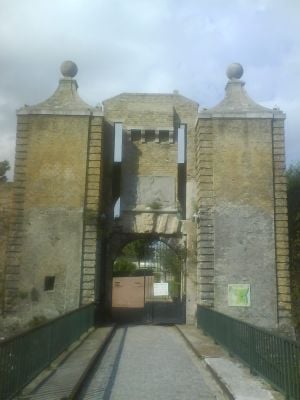
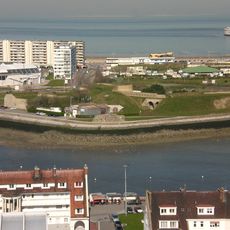
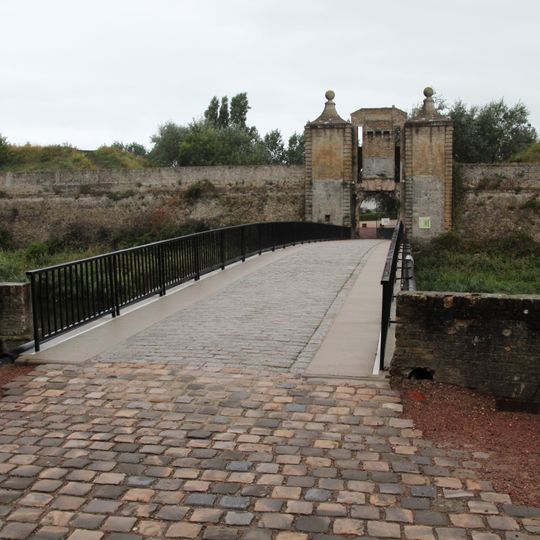
The Citadelle de Calais is a fortress begun in 1564 on the site of a 1229 medieval castle, northwest of the city. Its gate has two square towers of yellowish brick with lighter stone corner strips and rounded stone finials, flanking an arched passage topped by a carved stone panel. A medieval stretch of town wall with the Carrée and Pavée towers still stands.
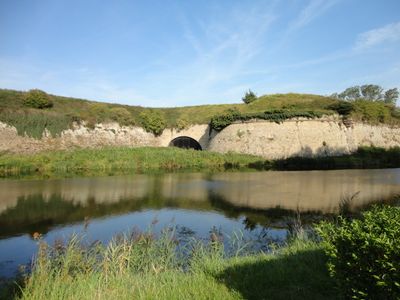
François II ordered a new citadel built on the site of the medieval castle of 1229, razed along with the church of Saint-Nicolas; the first stone was laid in 1564, the year England recognised Calais as French. Engineers Giacomo Castriotto and Jean Errard took part, Errard creating the half-moon of the Hermitage before the Porte de Neptune. In April 1596 the inhabitants took refuge there from the troops of Archduke Albert, but the sand-filled wall fell to cannon fire and Calais passed to Spain until the Treaty of Vervins in 1598.
The citadel's name recalls the medieval Château de Calais razed in 1564; the church of St. Nicholas, destroyed for the works, was rebuilt inside the ramparts in 1605 and served for baptisms and marriages until the Revolution, when it became a food store. The Porte de Neptune, a half-moon outwork, was designed by engineer Jean Errard.
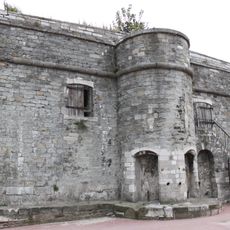
Access to the citadel passes through the half-moon of the Hermitage, then the Porte de Secours and the Porte de Boulogne. A medieval stretch of the town wall linking the Carrée Tower and the Pavée Tower still stands and can be seen on site.
Before moving to the Tour du Guet, Claude Chappe carried out the first tests of his aerial semaphore telegraph inside this citadel in 1816. The French source dates these trials to 1816, while the English article places them before the transfer without a year.
The community of curious travelers
AroundUs brings together thousands of curated places, local tips, and hidden gems, enriched daily by 92,796 contributors worldwide.