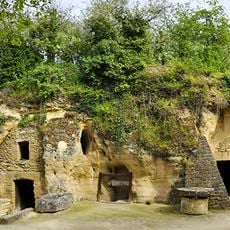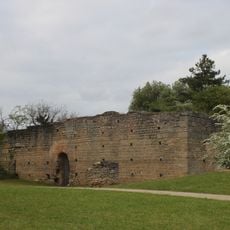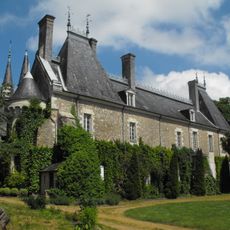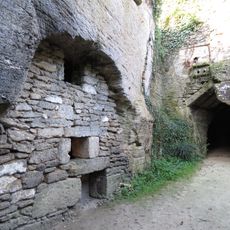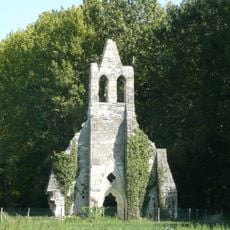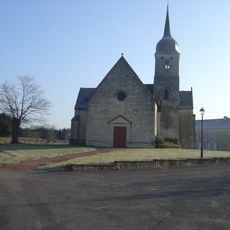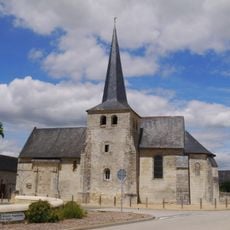
Caves des Mousseaux, Underground historical shelter in Dénezé-sous-Doué, France.
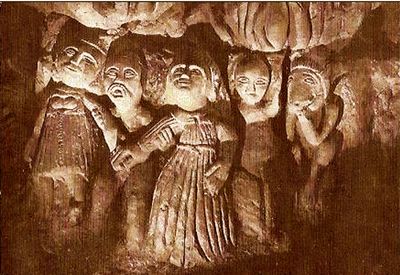
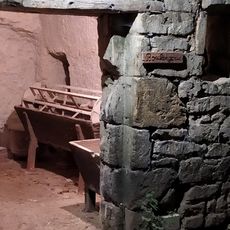
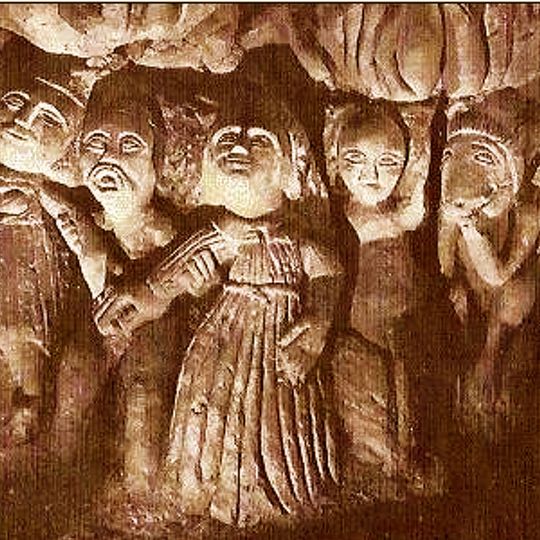
Caves des Mousseaux is a rock-cut shelter in Dénezé-sous-Doué whose tuffeau walls carry several hundred naive-style carved figures, about three hundred stylised characters crowded together in satirical scenes. In the photographed relief a tall central figure in a pleated, bell-shaped garment with crossed arms stands among figures with open mouths, beneath a band of rounded overlapping shapes.
The carvings in the tuffeau walls of these caves in Dénezé-sous-Doué date from the second half of the 16th century. A parish priest found them in the 18th century and, shocked by the nudity of some scenes, had them walled off. Two local ethnologists came across them again by chance in the 1930s. The site has been listed as a monument historique since 1969.
The figures are carved in a naive style, and many scenes appear satirical, aimed at the royal court and at Catholics. One scene shows a figure flanked by two women, one bare-breasted, in the fashion of Henri III's reign known as l'espoitrinement à la Vénitienne. The sculptors' identity and purpose remain unknown; Annie Bréthon, former manager of the caves, based hypotheses on the clothing shown.
Access to the caves is not currently possible as restoration work has been ongoing since 2019 to address damage caused by saltpeter, fungi, and algae affecting the delicate limestone carvings. Check current conditions before planning a visit.
The identity of the sculptors and their purpose remain unknown; researchers such as Annie Bréthon, a former curator of the caves, base hypotheses on details of dress. One scene shows a figure flanked by two women, one bare-breasted, following the fashion of Henri III's court known as l'espoitrinement à la Vénitienne.
The community of curious travelers
AroundUs brings together thousands of curated places, local tips, and hidden gems, enriched daily by 93,585 contributors worldwide.