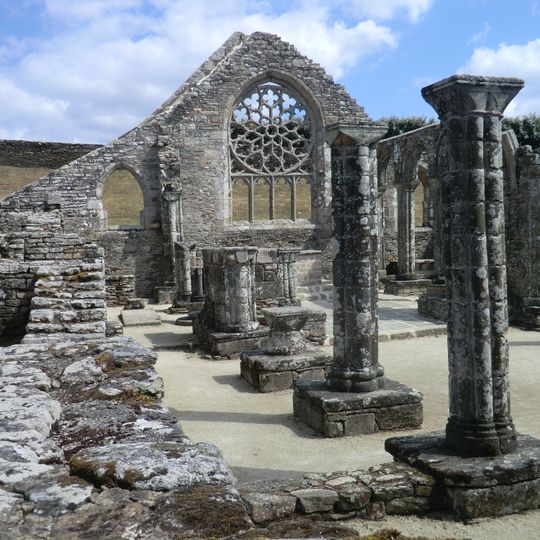
Chapelle de Languidou, Medieval chapel ruins in Plovan, France.
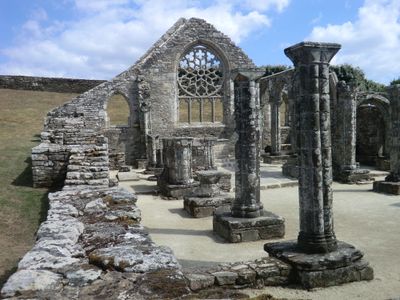
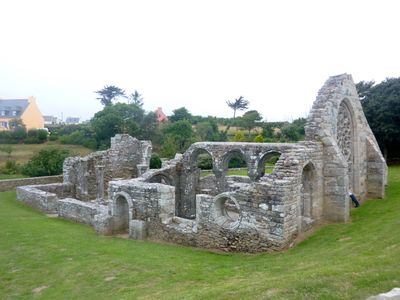
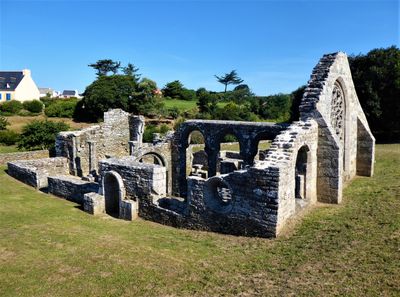
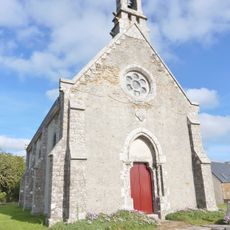
Chapelle de Languidou is a roofless ruin of grey and pale beige amphibolite and granite, measuring about 22 by 13 metres. Its west facade rises to a gable with a large Gothic window opening, a circular rose tracery above vertical divisions, and a smaller pointed arch to the left. Inside, thick cylindrical columns on square bases stand upright, one joined by low blocks and a stout round basin; low wall fragments lie around the perimeter.
The chapel was built during the 13th century and underwent changes in the 14th and 15th centuries. Revolutionary forces later dismantled portions of it to supply building materials for local construction projects.
The name Languidou comes from Breton Lan-, a prefix marking a monastic settlement founded by migrants from across the Channel, and Guidou, the little-documented Breton saint to whom the chapel is dedicated. He was later conflated with Saint Guy around the mid-18th century, apparently on purely phonetic grounds. The chapel's statue of the saint survives in the Saint-Gorgon church in Plovan.
The ruin stands in a small valley on the left bank of a stream opening onto the marshy lower coast of Audierne Bay, in Plovan. The ground is grassy and uneven, with low wall fragments around the perimeter, so sturdy footwear helps. The site is classified as a Monument historique and is maintained by the Association des Amis de Languidou.
The chapel is one of only two Breton sanctuaries dedicated to Saint Guidou, a poorly documented Breton saint later conflated with Saint Guy around the mid-18th century on purely homophonic grounds. His statue from Languidou is kept in the Saint-Gorgon church of Plovan. The name Languidou comes from Breton Lan-, a prefix marking a monastic settlement founded by migrants from across the Channel.
The community of curious travelers
AroundUs brings together thousands of curated places, local tips, and hidden gems, enriched daily by 93,478 contributors worldwide.