Camp celtique de la Bure, Archaeological site in Saint-Dié-des-Vosges, France.
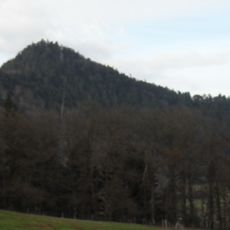
Camp celtique de la Bure occupies a sandstone promontory rising over 200 metres above the Meurthe valley, with a plateau about 350 metres long and 120 metres wide, covering just over 3 hectares. Its eastern end holds the main Gallic defensive system: a murus gallus wall discovered in 1976, up to 7.50 metres wide, 38 metres long and still 3 metres high, built of sandstone blocks with oak beams and iron pins. Three upright stone slabs stand on the terrace above a low dry-stone retaining wall.
Human settlement here spans from Neolithic times through the Roman period, as revealed by excavations conducted between 1964 and 1986. The successive layers of occupation show how this ridge remained important for defense and control across many centuries.
The site reveals how Gallic and Roman communities coexisted here through the artifacts they left behind, including coins, tools, and sculptures of gods. These objects now tell the story of two worlds meeting on the same hilltop.
Forest paths lead to the site from the hamlets of La Pêcherie and Marzelay, with a twenty-minute walk from Col de la Crenée providing the main approach. Sturdy footwear is advisable as the trails can be muddy or steep, depending on recent weather.
The oldest rampart, uncovered in 1976, dates to the second half of the 2nd century BC: a 38-metre-long wall up to 7.5 metres wide, still 3 metres high on its facade. Its two outer faces of squared sandstone blocks were tied by oak beams fixed with iron pins, thirteen of which were excavated. The core is stone and earth, in the Ehrang construction type.
The community of curious travelers
AroundUs brings together thousands of curated places, local tips, and hidden gems, enriched daily by 94,361 contributors worldwide.