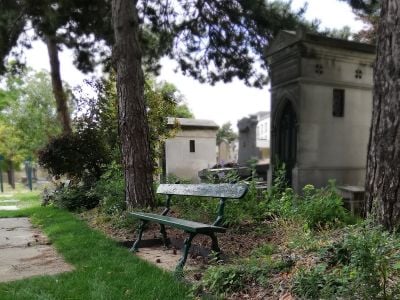
Cimetière de Belleville, Municipal cemetery in the 20th arrondissement of Paris, France
The cimetière de Belleville is a municipal cemetery in the 20th arrondissement of Paris, at the corner of rue de Belleville and rue du Télégraphe. It covers 1.80 hectares and holds 3,210 burial plots. The Belleville reservoir is built against its southern edge, where the main house of the Le Peletier de Saint-Fargeau estate once stood, and the square Belleville-Télégraphe is set into the cemetery at the same corner.
The cemetery was created between 1804 and 1808 on land that had been part of the former park of the Château de Ménilmontant, sold by an aristocrat named Suzanne Louise le Peletier de Saint-Fargeau. Its founding followed an imperial decree that banned burials inside city limits, which is why the elevated, outlying site was chosen.
The cemetery entrance on Rue de Belleville carries a plaque recalling Claude Chappe's optical telegraph experiments on this hilltop between 1790 and 1798. Among the graves are figures of Belleville and Parisian arts: painter Camille Bombois, organist Pierre Cochereau of Notre-Dame, and cinema pioneer Léon Gaumont.
The cemetery is reached on foot from Télégraphe metro station on line 11. It is bordered by rue de Belleville, rue du Télégraphe and villa des Hauts-de-Belleville, and the Belleville–Télégraphe square is set into its corner. The ground rises to 128.5 metres, the highest point in eastern Paris, so some paths are steep.
The cemetery occupies the highest point of eastern Paris, at 128.508 metres, and a plaque beside the main entrance records Claude Chappe's optical telegraph experiments on this spot between 1790 and 1798. The Belleville reservoir is built against the southern wall, where the main house of the Le Peletier de Saint-Fargeau estate once stood.
The community of curious travelers
AroundUs brings together thousands of curated places, local tips, and hidden gems, enriched daily by 93,136 contributors worldwide.