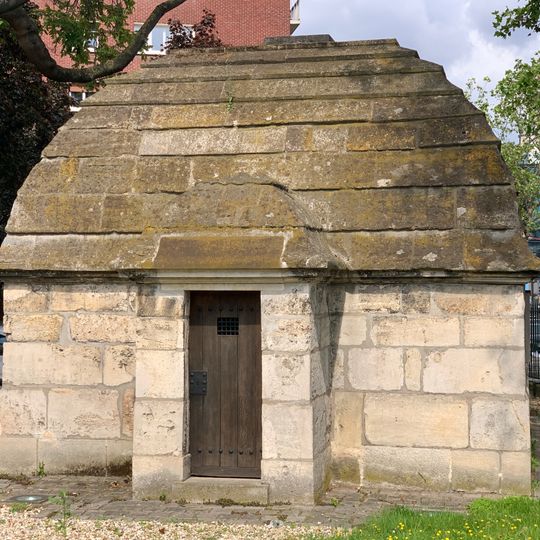
Regard des Maussins, A stone inspection chamber for a water conduit in the 19th arrondissement of Paris, France
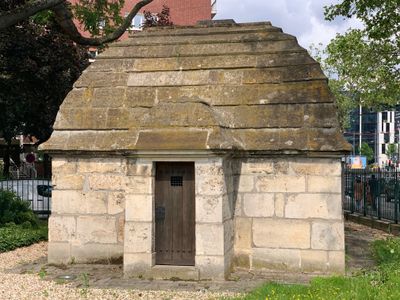
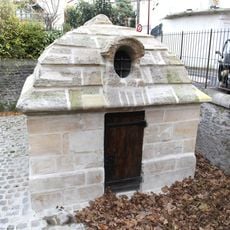
The Regard des Maussins is a small rectangular stone building at the corner of Boulevard Sérurier and Avenue de la Porte-des-Lilas in the 19th arrondissement. Its walls are large light-grey ashlar blocks, and its pavilion roof is laid with rows of rectangular stone slabs in grey and greenish tones, stepping down to a slight overhang. A dark plank door with iron studs and a square grated opening sits centred beneath a stone lintel.
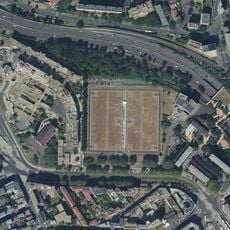
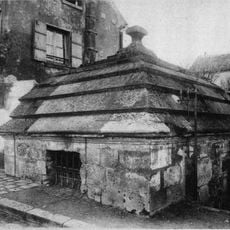
The Regard des Maussins was built in the Middle Ages as part of the Eaux du Pré-Saint-Gervais works, which carried water from the sources of the Lilas hill to the Saint-Lazare priory in Paris. It was renovated in the 18th century and classified as a monument historique in 1899. Originally standing on the commune of Pré-Saint-Gervais, 350 m further north, it was moved to its present site in 1963 during the construction of the boulevard périphérique, which allowed the Lilas reservoir to be built.
The Regard des Maussins shows how medieval Parisians organized and monitored their city's water systems. The small stone building reminds visitors today of the practical solutions people once created to control water and serve their communities.
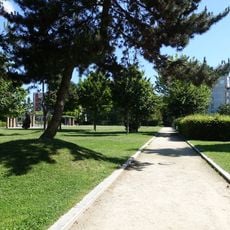
The Regard des Maussins stands at the corner of Boulevard Sérurier and Avenue de la Porte-des-Lilas, in the 19th arrondissement, served by the Porte des Lilas metro station. It is a small stone structure visible from the public street; the sources record no opening to visitors, no garden and no Heritage Days access.
The building was relocated about 350 meters from its original site in Pré-Saint-Gervais in 1963 to make room for modern transportation and the reservoir construction project. This relocation made it one of the few medieval water transport structures that was physically moved to adapt to the modern city.
The community of curious travelers
AroundUs brings together thousands of curated places, local tips, and hidden gems, enriched daily by 94,223 contributors worldwide.