Varengeville-Sur-Mer Churchyard, Historic church cemetery on coastal cliffs in Varengeville-sur-Mer, France
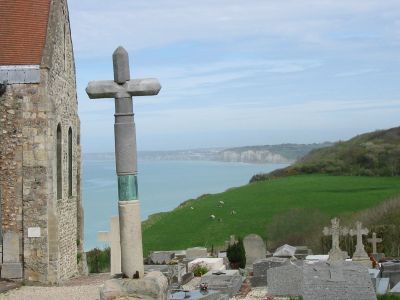
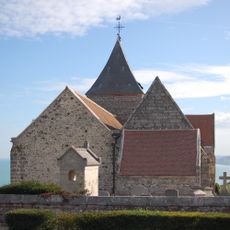
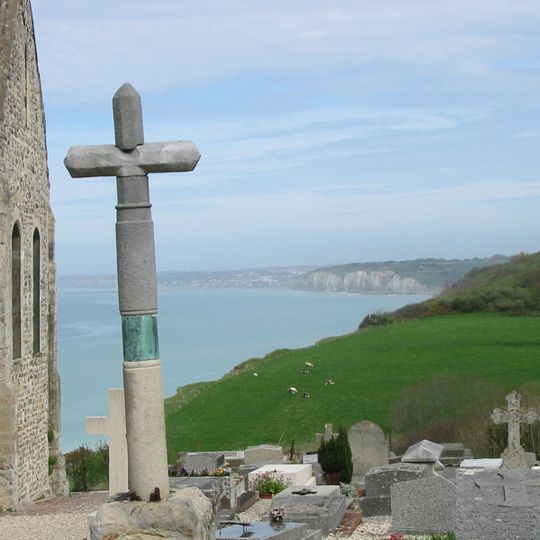
Varengeville-sur-Mer Churchyard surrounds the Church of Saint-Valery on the cliff edge above the sea. A tall stone cross with short arms stands on a pale stone block, its shaft bound by a greenish-blue band between two carved rings. Plain stone grave markers and a low stone basin lie nearby, with green fields sloping down behind the graves toward the water.
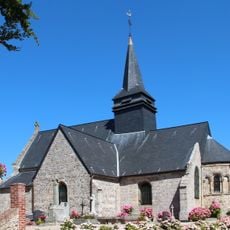
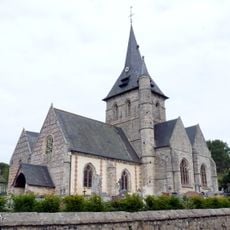
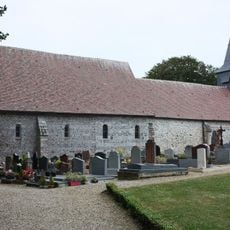
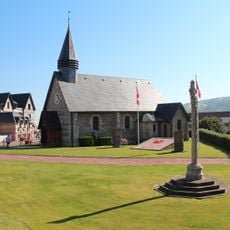
The churchyard surrounds the church of Saint-Valery. The ensemble of church and cemetery has been classified as a monument historique since 6 March 1924. The site is threatened by erosion of the cliff along which it lies. Notable burials include the painters Georges Braque and Michel Ciry, the composer Albert Roussel and the mathematician Raphaël Salem.
The painter Georges Braque (1882–1963) lived and worked in this Norman village and is buried here; his grave is decorated with a blue mosaic showing a bird. The cemetery surrounds the church of Saint-Valery, and the two together have been listed as a monument historique since 6 March 1924.
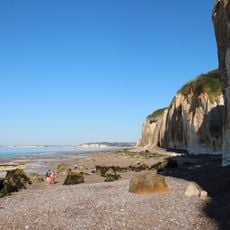
The churchyard surrounds the Church of Saint-Valery west of Dieppe; the two together have been classified as a monument historique since 6 March 1924. The site stands on the cliff edge above the sea, and the cliff is eroding, so keep to the paths and away from the rim. The ground is uneven grass among the graves, best covered on foot.
The cemetery served as a filming location for the 1974 comedy Le Retour du Grand Blond, in the scene staging fake funerals. Among the graves is that of painter Georges Braque, whose tomb is decorated with a blue mosaic depicting a bird.
The community of curious travelers
AroundUs brings together thousands of curated places, local tips, and hidden gems, enriched daily by 93,358 contributors worldwide.