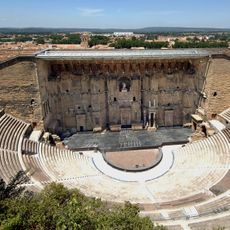
Colline Saint Eutrope, Archaeological site and historic monument on Saint Eutrope hill in Orange, France.
Colline Saint-Eutrope rises to 105 m in the centre of Orange, about 11% of the town's height, overlooking the Roman theatre below to the north. The 9.45-hectare hill holds the remains of the princes of Orange's castle: the 14th-century keep, curtain walls and the Vignasse esplanade, plus a monumental statue of the Virgin Mary, four panoramic viewpoints and an orientation table.
In the 12th century Tiburge, daughter of Count Raimbaud of Nice, rebuilt the ancient walls and the old castrum Aurasice. In the 14th century the Princes of Baux strengthened the keep and ramparts against the Great Companies, and Jean de Chalon added three wings to the keep. From 1621 to 1624 Maurice of Nassau built a modern fortress with eleven bastions, destroyed in 1672 on Louis XIV's orders.
The hill's 9.45 hectares, with the remains of the princes of Orange's castle, were inscribed on the UNESCO World Heritage list in 2007 alongside the Roman Theatre and the Triumphal Arch of Orange. The hill itself was classified as a protected environmental site in 1935 over 25 hectares.
The site features walking paths, viewing areas, and access routes to the archaeological remains. Visitors should wear appropriate footwear as the hill has slopes and the paths cross uneven ground.
Queen Juliana of the Netherlands planted an oak tree here in 1952 to mark the historical connection between Orange and Dutch heritage. The tree stands as a reminder of the former Dutch rule over the city.
The community of curious travelers
AroundUs brings together thousands of curated places, local tips, and hidden gems, enriched daily by 92,726 contributors worldwide.