Cloître de la Psalette, Cloister in the Saint-Gatien district, Tours, France
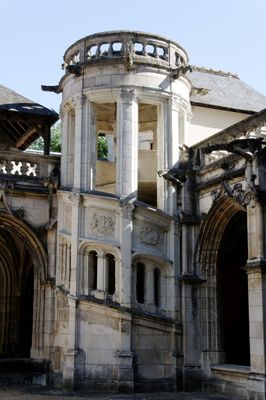
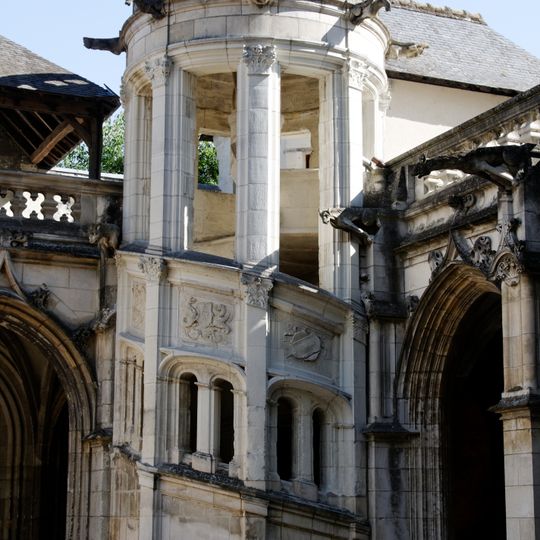
The Psalette cloister is the cloister of Tours Cathedral, in the Saint-Gatien quarter of Old Tours. Its buildings were begun in the 15th century under the patronage of Archbishop Jean de Bernard and finished in the 16th. The photograph shows two storeys of pale limestone: an upper level of tall slender arches on rounded columns with carved capitals, a lower level of small twin arched windows and carved square panels, a dark timber pent roof above a low balustrade pierced by circular openings, and a pointed Gothic archway with carved figures on its mouldings.
The cloister served as the working place of the canons of Tours Cathedral from the early Middle Ages. The present buildings were constructed from the 15th century under the patronage of Archbishop Jean de Bernard and completed in the 16th century. The chapter was dissolved in 1793 during the Revolution and its library dispersed.
The name Psalette comes from the psalms sung by the adjoining music school. The canons' chapter had a scriptorium and one of France's richest libraries, dispersed when the chapter was dissolved in 1793. Honoré de Balzac set his novel Le Curé de Tours in the cloister.
The cloister stands in the Saint-Gatien quarter of Old Tours, beside the cathedral, and is managed by the Centre des monuments nationaux. Entry is through the cloister itself rather than the cathedral; the galleries and the north-east spiral staircase are seen on foot. The courtyard is small, so allow a short visit.
The spiral staircase in the north-east corner is attributed to Bastien François and looks like a miniature version of the one at Blois Castle commissioned by Francis I. The chapter's library was among the richest in France before the canons were dissolved in 1793 and the books dispersed.
The community of curious travelers
AroundUs brings together thousands of curated places, local tips, and hidden gems, enriched daily by 94,319 contributors worldwide.