Couvent Saint-François, Franciscan monastery in 14th arrondissement, France
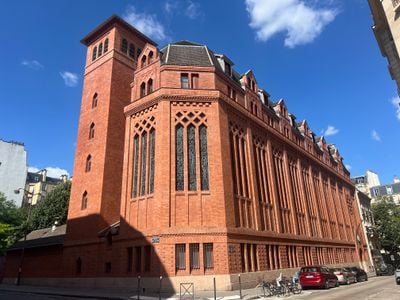
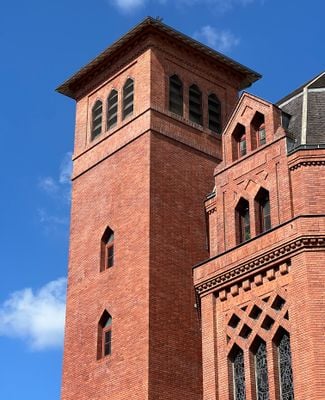
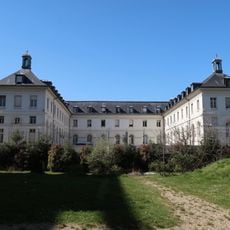
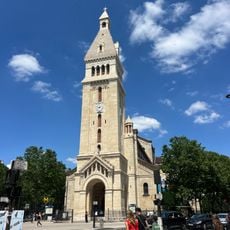
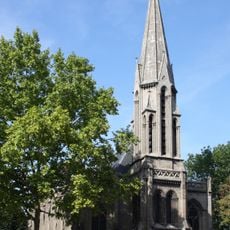
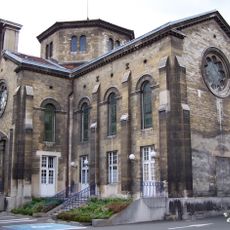
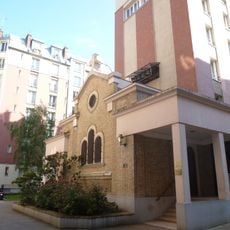
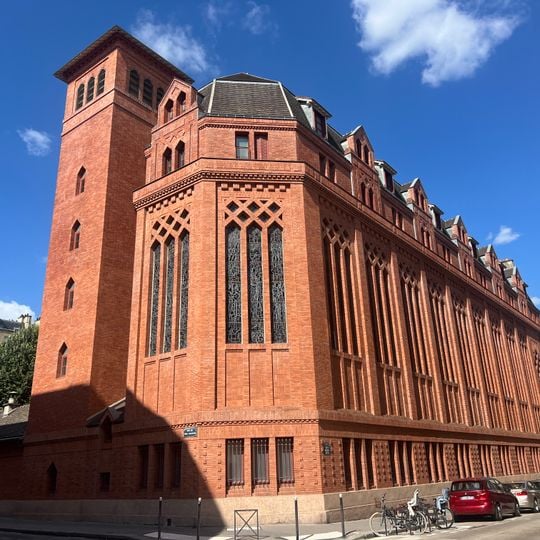
Couvent Saint-François is a red-brick Franciscan convent at 7 rue Marie-Rose, built 1934–1935 by Victor Blavette, Paul Gélis and Louis-Jean Hulot in the spirit of Dom Bellot. A square flat-topped tower with tall pointed louvered openings rises beside a steep gabled block; pointed windows with tracery run above a band of small rectangular windows. The chapel, consecrated in 1936, is also brick, with rose-coloured Burgundy stone, a nave lined by lateral chapels and a choir behind a triumphal arch.
The monastery was built between 1934 and 1935 after French Franciscans returned following World War I. This construction marked their return to France after being expelled by the law of 1905.
The chapel's stained glass is by André Pierre, Pierre Villette and Claude Malespine; three choir windows depict the three orders founded by Saint Francis of Assisi. The nave is lined with lateral chapels on the south side, separated by pointed brick arches, and a triumphal arch opens onto the choir.
The convent stands at 7 rue Marie-Rose, between rue Sarrette and rue de la Voie-Verte in Petit-Montrouge. The chapel, part of the interior decoration, the staircase, the vestibule and the cloister are listed as monuments historiques since 22 October 2007. Only part of the convent is open to the public, chiefly the chapel; look for the small blue street sign low on the brick wall.
Father Corentin Cloarec (1894–1944), chaplain to the Resistance at place Denfert-Rochereau, was assassinated in the convent by Gestapo members on 28 June 1944. In 1945 a neighbouring street was named rue du Père-Corentin after him.
The community of curious travelers
AroundUs brings together thousands of curated places, local tips, and hidden gems, enriched daily by 92,634 contributors worldwide.