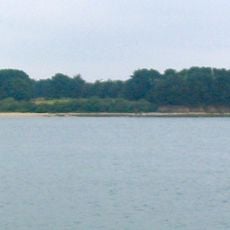
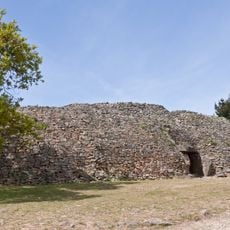
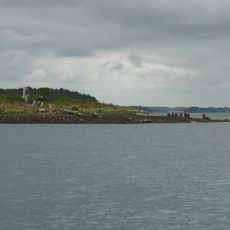
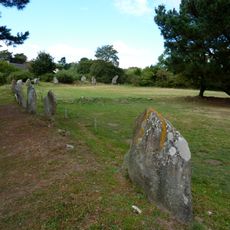
Dolmen de Penhap, Neolithic burial monument in Île-aux-Moines, France.
The dolmen de Penhap is a passage tomb with a bent corridor of three upright stones and a capstone leading into a quadrangular chamber. Nine orthostats support a single capstone 4.8 m long, 3.6 m wide and 0.95 m thick. The entrance's left pillar (C1) bears engravings on both faces.
The dolmen is the only survivor of a row of monuments once covered by an 80-metre cairn, largely destroyed by 1825. Abbé Joseph Mahé visited in 1819 and saw a line of small mounds with a pyramidal menhir on the easternmost. P. Lucas drew a plan in 1852, and Alphonse Mauricet excavated in 1877 without finding archaeological material. It was classified as a historical monument on 29 October 1979.
The first stone on the left at the chamber entrance (orthostate C1) carries two engraved motifs. A. de Mortillet read the inner one as an axe in its sheath, while Serge Cassen proposed a squid on the inner face and a sperm whale on the outer one. The outer motif, the "hache-charrue", recurs at Mané Lud, Kermaillard, Gavrinis and Er Grah. In the 19th century a fishing family lived inside the chamber.
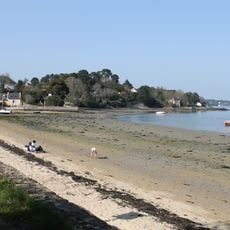
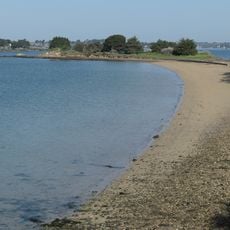
The dolmen lies in the south of the Île-aux-Moines, near the Pointe de Penhap, on bare sandy ground reached by the island's footpaths; the uprights stand in low vegetation, so watch your footing around the stones. The chamber is about 1.8 m high and entered through a bent passage roughly 3 m long, so you can look in but not stand upright inside.
The chamber once sheltered a fishing family in the 19th century, and when Alphonse Mauricet excavated it in 1877 he recovered no archaeological material. The first left-hand orthostat at the chamber entrance carries two carvings: Serge Cassen reads the inner face as a squid and the outer face as a sperm whale, while earlier scholars saw a hafted axe and a "plough-axe".
The community of curious travelers
AroundUs brings together thousands of curated places, local tips, and hidden gems, enriched daily by 94,588 contributors worldwide.