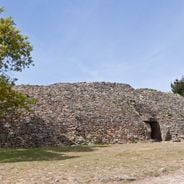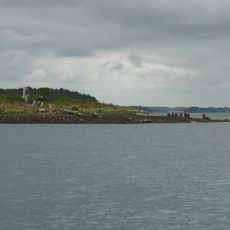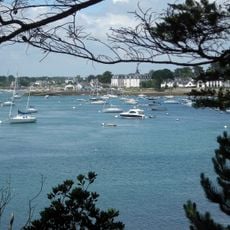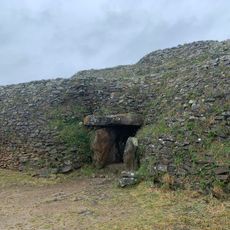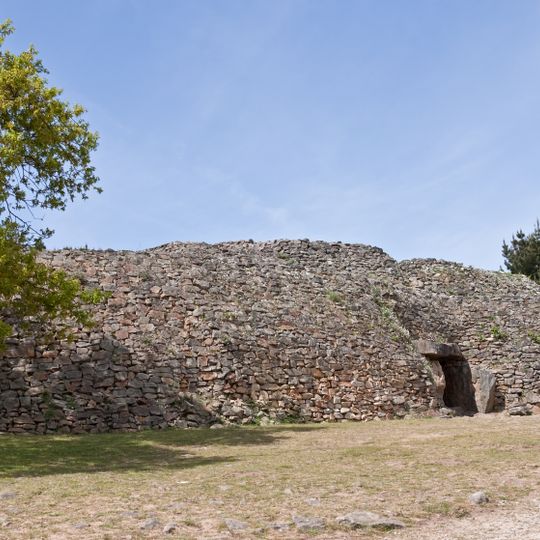
Cairn de Gavrinis, Neolithic passage tomb on Gavrinis Island, Larmor-Baden, France.
The cairn de Gavrinis is a stone burial monument with a narrow passage around 14 meters long leading to a central chamber supported by 29 large stones. The entire structure spans about 50 meters across and was built by stacking countless stones to protect this inner chamber.
The monument was built around 3500 BCE and originally served as a burial place for the community. After roughly 3000 BCE, it fell out of use, and sand and earth gradually covered it until it resembled a natural hill.
The passage's 29 orthostats carry curvilinear engravings, and Prosper Mérimée in 1836 noted curves, chevrons and zigzags resembling writing. The chamber's ceiling slab, reused from an older monument, bears a bovid and a goat on its hidden face, found in 1984. Visitors see the carvings on a guided tour.
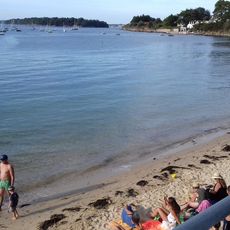
The site is reached only by boat from Larmor-Baden, with the crossing taking about 10 minutes and operating during warmer months. Visits to the interior are organized through guided tours, allowing you to see the chamber and passage without spending much time outdoors.
The slab covering the chamber was reused: its hidden face, exposed in 1984, carries a bovid, the horns of a caprine and a debated motif. Charles-Tanguy Le Roux showed by studying fractures and carvings that this slab, one from the Table des Marchand and one from Er Vingle at Locmariaquer, about 4 km away, once formed a single 14 m menhir later cut up to roof tombs.
The community of curious travelers
AroundUs brings together thousands of curated places, local tips, and hidden gems, enriched daily by 94,532 contributors worldwide.