Ermitage Saint-Gerbold, hermitage in Gratot, Normandy, France
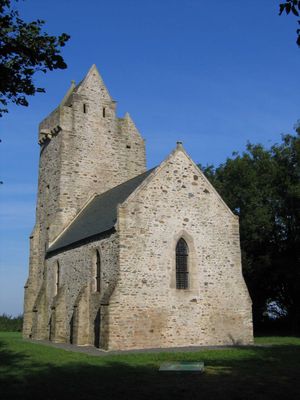
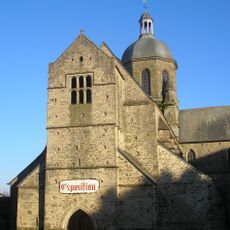
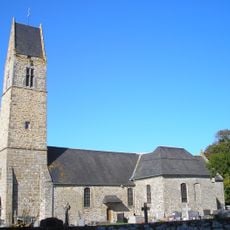
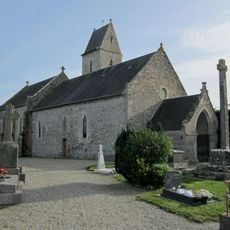
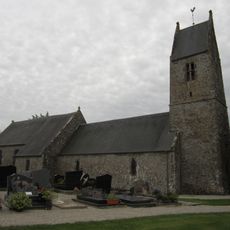
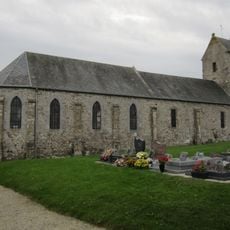
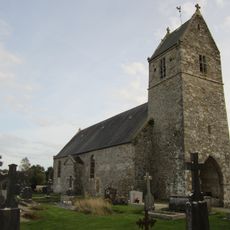
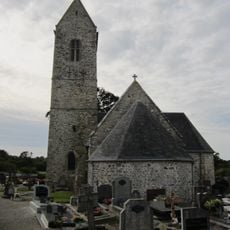
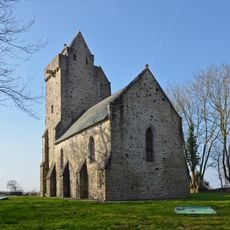
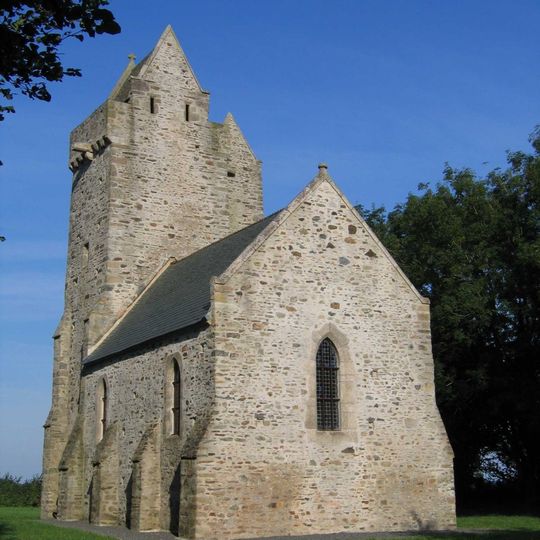
The Ermitage Saint-Gerbold in Gratot consists of a rough light-grey and tan stone chapel with a tall square tower on the left, rising in set-back stages with small rectangular openings, a projecting corbel table and a steep pyramidal roof. To the right, a lower gabled nave with a dark grey pitched roof ends in a rounded apse-like wall lit by a tall pointed window with simple tracery. Small arched windows pierce the side walls above low buttresses, and trees surround the building.
Philippe d'Argouges, lord of Gratot, had a chapel dedicated to Saint Gerbold built between 1403 and 1418; Gerbold was a 7th-century bishop of Bayeux, the family's city of origin. Between 1619 and 1623 the chapel became a hermitage, home to a hermit in the 17th and 18th centuries. Seized and sold as national property during the Revolution, it returned to the d'Argouges and housed a last hermit until 1830. Classified in 1995, it was bought by the Manche departmental council in 2000 and restored, opening to the public in 2006.
The chapel is dedicated to Saint Gerbold, a 7th-century bishop of Bayeux, the city the d'Argouges family came from; his feast is 7 December and he is invoked against digestive ailments. A local legend tells of a tunnel linking the hermitage to the château a kilometre away. Gilles Dancel, hermit here until 1660 as brother Gilles de Saint-Joseph, wrote La Trompette de l'Union for Louis d'Argouges.
The grounds around the hermitage are open for self-guided visits at all times, while the building itself opens for guided tours only at certain periods, including the Journées du patrimoine. Information panels on the surrounding site cover the saint's legend, the building's evolution and the hermits' daily life. The hermitage stands about one kilometre east-northeast of the Château de Gratot.
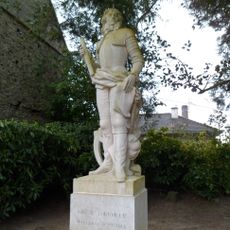
During restoration work, workers discovered a stone statue of Saint Gerbold from the 15th century buried in the ground, hidden away during times of unrest. This rare statue was later displayed in exhibitions, revealing the importance of this place in local religious history.
The community of curious travelers
AroundUs brings together thousands of curated places, local tips, and hidden gems, enriched daily by 94,528 contributors worldwide.